
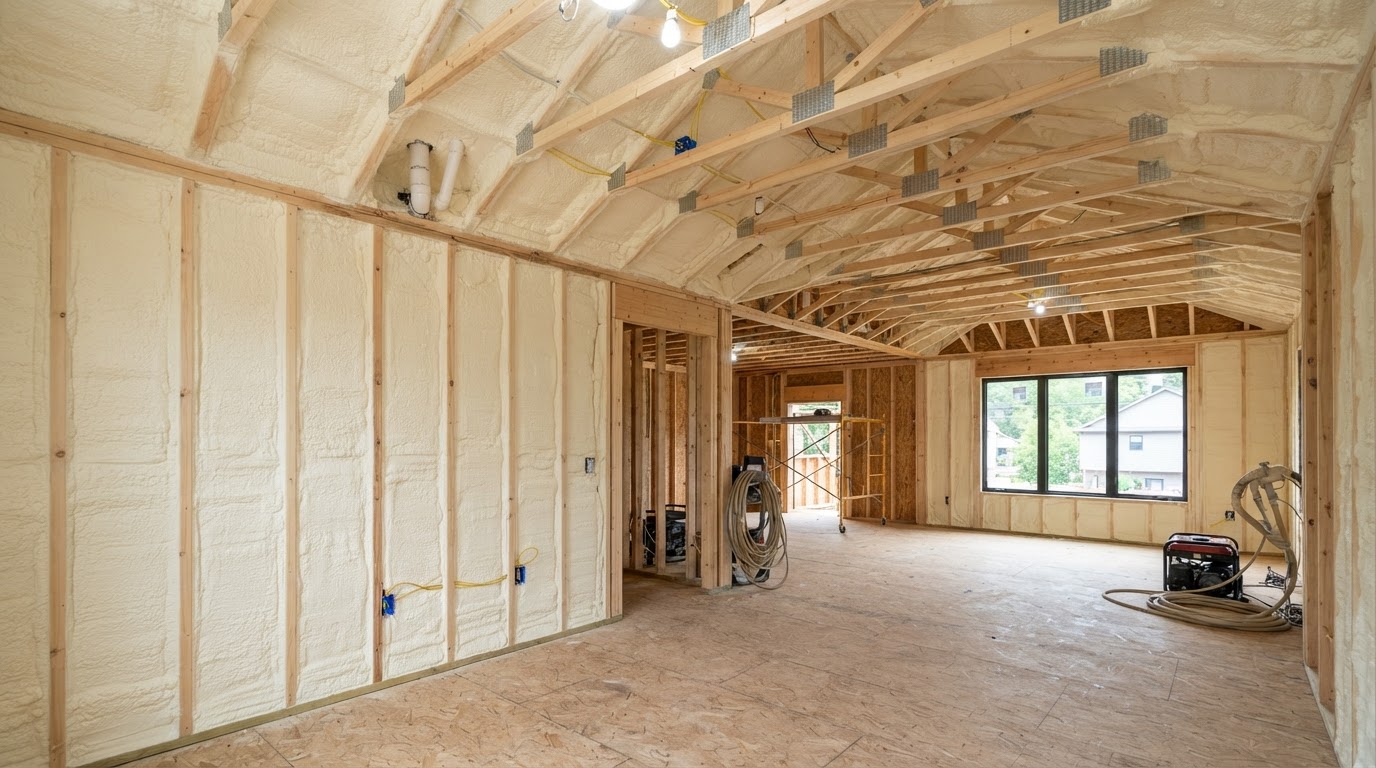
Spray Foam Insulation Resources for North Alabama
This resource center is designed for homeowners, builders, facility managers and property owners researching spray polyurethane foam, building assemblies, project planning and insulation options in the North Alabama climate. Use it to understand foam types, cost factors and the questions to answer before choosing an insulation assembly.
Start With Your Project Type
The right approach depends on the building, the assembly and whether the work is new construction or a retrofit. Begin with the project type that matches your situation.
Home / Retrofit
Existing homes, additions and retrofit assemblies.
Attic / Roofline
Unvented roof decks and conditioned attic planes.
Crawl Space
Foundation stem walls and subfloor assemblies.
Metal Building
Steel-frame and metal-panel structures.
Commercial / Industrial
Warehouses, manufacturing and commercial buildings.
New Construction
Open framing and builder-coordinated projects.
Understanding Spray Foam
What spray foam is
Spray polyurethane foam (SPF) is a two-component liquid that expands on application to fill gaps, cracks and framing irregularities, creating a continuous air barrier.
Open-cell foam
Lightweight and flexible, open-cell foam expands to fill deep framing cavities and is commonly used in interior wall and attic assemblies.
Open Cell detailsClosed-cell foam
Dense and rigid, closed-cell foam offers high R-value per inch and can act as a vapor retarder at a specified thickness.
Closed Cell detailsAir sealing
SPF expands to seal gaps around framing, wiring and plumbing penetrations, helping reduce uncontrolled air leakage through the building envelope.
Thermal resistance
R-value describes resistance to heat flow; total performance also depends on thickness, assembly design and continuity.
Vapor & envelope continuity
Vapor characteristics and continuous coverage matter for moisture control and long-term building-envelope performance.
Questions to Answer Before Choosing an Insulation Assembly
These questions help frame an insulation decision. They do not replace evaluation of a specific assembly, local code review, manufacturer requirements or engineering where required.
Cost & Project Planning
Spray foam pricing depends on factors such as surface area, foam type, application thickness, access, building height, preparation, masking, existing insulation, substrate condition, complexity and application area. For an in-depth look, see the spray foam cost guide.
Spray Foam Planning Guides & Tools
Authoritative resources for homeowners, builders and commercial property owners researching spray foam cost, board-foot volume, R-value, foam-type selection, assemblies, codes and installation safety in the North Alabama climate.
Planning & Cost
Spray Foam Insulation Cost Guide
What affects spray foam cost in Madison and North Alabama — foam type, thickness, access, removal and preparation.
Read guideSpray Foam Board-Foot Calculator
Estimate theoretical foam volume from square footage and thickness, with an optional waste allowance.
Read guideSpray Foam R-Value & Thickness Guide
How R-value, thickness, density and assembly design affect open-cell and closed-cell foam performance.
Read guideCommercial Bid & Specification Checklist
Organize plans, square footage, assemblies, foam specifications, access, scheduling and bid information.
Read guideChoosing an Insulation System
Open Cell vs Closed Cell Spray Foam
Compare density, R-value, vapor permeability, rigidity, cost tendencies and common applications.
Read guideSpray Foam vs Fiberglass vs Cellulose
Compare spray foam, fiberglass and cellulose by air sealing, cavity fit, moisture behavior, retrofit use and cost tendency.
Read guideOld Insulation Removal & Spray Foam Upgrade
When fiberglass, cellulose or damaged insulation may need removal before spray foam, and when existing material may remain.
Read guideAttics & Rooflines
Vented vs Unvented Attics in North Alabama
Compare vented and unvented attic assemblies — roofline insulation, attic-floor insulation, HVAC location and moisture.
Read guideCan You Spray Foam the Underside of a Roof Deck?
When spray foam may be applied to the underside of roof decking, and the conditions to check first.
Read guideCrawl Spaces & Foundations
Crawl Space Encapsulation vs Floor Insulation
Compare encapsulation, perimeter wall insulation and floor-joist insulation for North Alabama crawl spaces.
Read guideSpray Foam, Termites & Inspection Access
How spray foam insulation affects termite inspection visibility around crawl spaces, foundations, and wood framing in Alabama.
Read guideCodes, Safety & Building Science
Ignition vs Thermal Barriers
The code difference between ignition barriers and thermal barriers for attics, crawl spaces, and living areas.
Read guideMadison & Huntsville Building Code Guide
Current local building codes, energy conservation standards, and permit requirements for spray foam projects.
Read guideSpray Foam Safety, Ventilation & Re-Entry
Installation safety, work-area isolation, ventilation, PPE, re-entry and re-occupancy considerations.
Read guideHow to use this resource center: General educational information here does not replace evaluation of a specific assembly, local permit or code review, manufacturer requirements, architectural specifications or engineering where those are required. Always confirm foam type, thickness and fire-protection requirements for your specific project.
Still Have Questions About Your Project?
The best next step is a project-specific evaluation. Share your building type, application area and a few details so we can provide a meaningful response.