
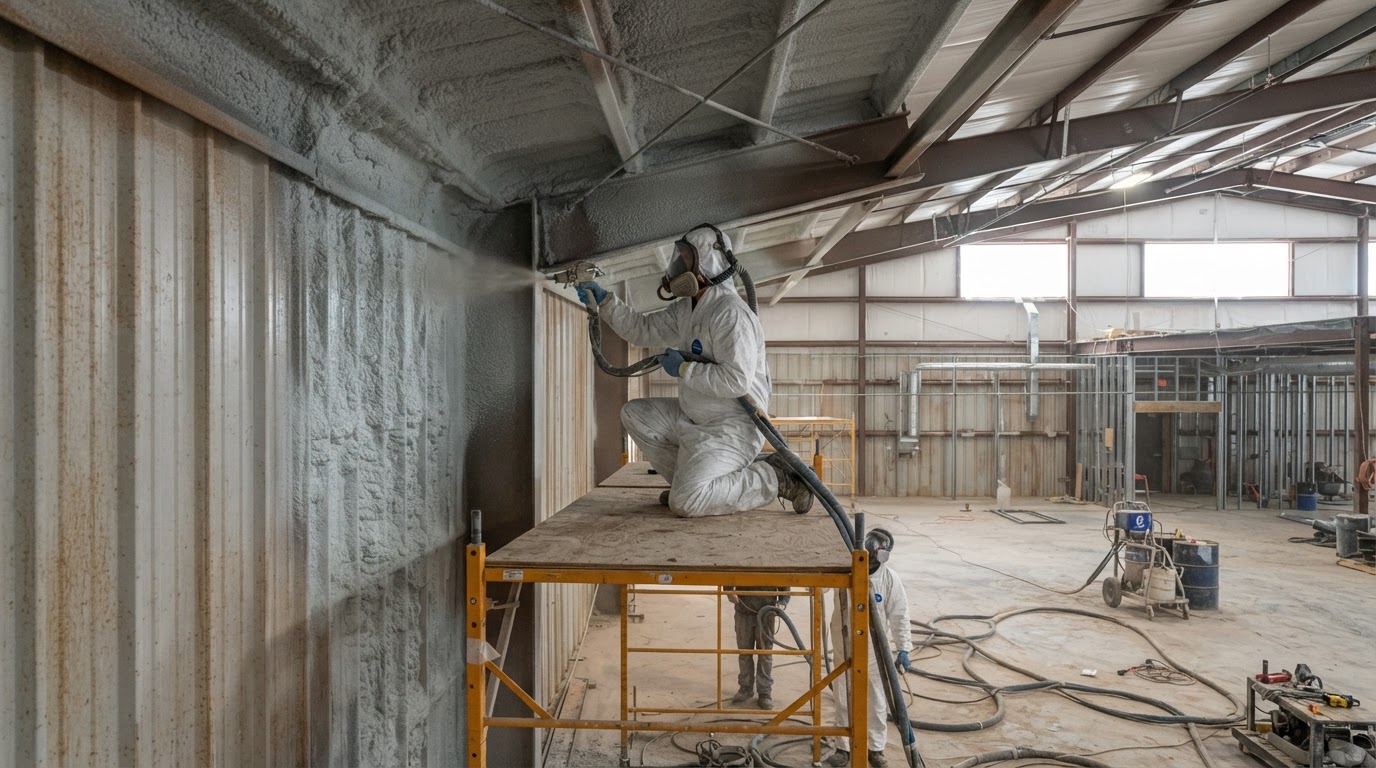
Commercial & Industrial Spray Foam Insulation in North Alabama
Spray polyurethane foam may be used in qualifying commercial and industrial wall, roof, metal-panel and building-envelope assemblies where air sealing and thermal insulation are part of the project requirements. Madison Spray Foam Installation evaluates commercial and industrial projects throughout Madison, Huntsville and the surrounding North Alabama region — not every commercial building is suitable, so each assembly is reviewed before a recommendation is made.
Commercial Spray Foam Applications
Commercial and industrial spray foam is typically evaluated for assemblies such as roof decks, exterior wall assemblies, metal wall and roof panels, framed walls, rim and perimeter transitions, additions and retrofit assemblies. The appropriate foam, thickness and preparation depend on the building assembly, substrate and project requirements.
Commercial & Industrial Building Types
We evaluate spray foam for a range of commercial and industrial building types. Where a dedicated page already exists, the card links to it; other types are described here and will be expanded into dedicated pages in later phases.
Warehouses
Large storage and distribution buildings with tall walls and expansive roof areas.
Manufacturing Facilities
Production floors where temperature stability and air sealing support process conditions.
Flex & Light Industrial Buildings
Mixed-use flex and light-industrial structures combining office, storage and workshop space.
Metal Commercial Buildings
Pre-engineered and steel-frame commercial buildings with metal wall and roof panels.
Aircraft Hangars
Large clear-span metal hangar structures with high ceilings and expansive metal surfaces.
Industrial Facilities
Industrial buildings, production spaces and equipment buildings where envelope performance is evaluated.
Office & Retail
Office, retail and service buildings where comfort and envelope performance matter.
Commercial Roof Deck
Underside roof-deck insulation for qualifying warehouse, industrial and office assemblies.
Commercial Building Envelope
Wall systems, roof transitions, perimeter assemblies and air sealing for commercial buildings.
Commercial Retrofit
Insulation upgrades for existing warehouses, offices, metal buildings and industrial facilities.
General Contractors & Home Builders
Spray foam scopes for new construction, additions and commercial builds coordinated with other trades.
Commercial Air Sealing & Thermal Envelope
Air-sealing and thermal-envelope continuity for wall, roof and transition assemblies.
CMU & Masonry Wall Spray Foam
Spray foam for qualifying CMU, concrete-block and masonry-adjacent wall assemblies.
Multifamily Buildings
Multifamily and attached housing assemblies with shared walls and rooflines.
Churches & Worship Facilities
Large-volume worship and gathering facilities with high ceilings and varied assemblies.
Self-Storage Facilities
Self-storage buildings with metal partitions and climate considerations for tenant units.
Automotive / Service Buildings
Automotive service and repair buildings where temperature and condensation are concerns.
Open Cell vs Closed Cell for Commercial Projects
Product selection depends on the assembly, design requirements, required thermal resistance, vapor control, framing depth, exposure, substrate, fire-protection requirements and specification requirements. Closed-cell foam is not automatically required for every commercial project.
| Consideration | Open-Cell Foam | Closed-Cell Foam |
|---|---|---|
| Density | ~0.5 lb/cu. ft. (lightweight) | ~2.0 lb/cu. ft. (dense, rigid) |
| Relative R-value / inch | Lower per inch | Higher per inch |
| Vapor permeability | Vapor-permeable (breathes) | Vapor retarder at specified thickness |
| Rigidity | Flexible, soft | Rigid, can add assembly rigidity |
| Typical commercial use | Interior framed walls, sound control, deep cavities | Metal panels, crawl spaces, exposed assemblies, moisture zones |
The appropriate foam depends on the building assembly, substrate, moisture exposure, framing depth, code requirements and project objectives.
Commercial Retrofit vs New Construction
New Construction
- Open access to framing during the construction stage
- Sequencing coordinated with other trades
- Plans and specifications available for review
- Foam applied at the framing stage of the assembly
Retrofit
- Existing materials and substrates must be evaluated
- Access may be limited by finished surfaces
- Occupied-building considerations and phasing apply
- Existing insulation may need to be addressed first
Metal Buildings & Condensation Considerations
Interior metal surfaces can experience condensation when warm, humid air reaches a metal surface that is below the dew point. In North Alabama's humid climate, this is a common concern for metal commercial buildings, workshops and storage structures.
Directly adhered insulation can be part of an assembly designed to reduce uncontrolled air contact with metal panels and to moderate interior surface conditions. Spray foam does not permanently eliminate all condensation — outcomes depend on the assembly, foam type, thickness, ventilation, interior conditions and the building's use.
Working With General Contractors, Builders & Property Owners
The following details help us evaluate a commercial spray foam project and provide a meaningful proposal:
This list describes estimating inputs only. It does not represent claims of prevailing-wage compliance, bonding capacity, large-project bonding, special certifications or government contracting capabilities.
Commercial Project Evaluation Process
Project Scope
We review building use, target insulation areas, square footage, height and access requirements.
Plans / Site Review
Plans, specifications or a site visit help us evaluate the wall, roof and metal-panel assemblies involved.
Assembly Evaluation
We assess substrate, framing, moisture exposure, fire-protection needs and code considerations.
Proposal & Scheduling
We provide a written proposal with foam type, thickness, scope and a proposed schedule.
Site Preparation / Application
Surfaces are masked and protected, then foam is applied in controlled passes by trained crews.
Completion Review
We verify coverage, thickness and continuity before the area is returned for other trades.
Commercial Service Region
Madison and Huntsville are core markets, and qualifying projects are evaluated throughout the existing North Alabama service region. Larger commercial and industrial projects may be evaluated outside the typical residential service radius based on project scope and scheduling.
Frequently Asked Commercial Spray Foam Questions
Can spray foam be used in warehouses?
Yes. Spray foam may be applied to qualifying warehouse wall, roof-deck and metal-panel assemblies where air sealing and thermal insulation are part of the project requirements. Suitability depends on the assembly, substrate, fire-protection requirements and code considerations.
Can spray foam be applied to metal commercial buildings?
Yes. Spray polyurethane foam adheres directly to steel framing and metal panels, which can help reduce the uncontrolled air contact that contributes to interior surface condensation. Foam selection and thickness depend on the panel profile, building use and specification.
Can existing commercial buildings be retrofitted?
Yes, qualifying existing commercial buildings can be retrofitted when the substrate is accessible, clean and dry. Retrofit work may involve removing existing insulation, addressing moisture sources and sequencing around occupied-building considerations.
Which type of spray foam is used for commercial projects?
Either open-cell or closed-cell foam may be appropriate depending on the assembly, required thermal resistance, vapor control, framing depth, substrate, exposure and fire-protection requirements. Closed-cell is not automatically required for every commercial project.
Can spray foam be installed on commercial roof-deck assemblies?
Spray foam can be applied to the underside of qualifying roof-deck assemblies as insulation within the building envelope. This is distinct from exterior spray polyurethane foam roofing, which is a separate service not advertised here.
What information is needed for a commercial estimate?
Useful details include project location, plans or specifications, wall and roof assembly, approximate square footage, substrate, target insulation area, building height, access requirements, construction schedule, desired foam type if specified, and any known fire or thermal barrier requirements.
Request a Commercial Spray Foam Project Evaluation
When available, please provide plans, dimensions, building use and timeline. Sharing these details helps us evaluate your commercial or industrial spray foam project and provide a meaningful response.