
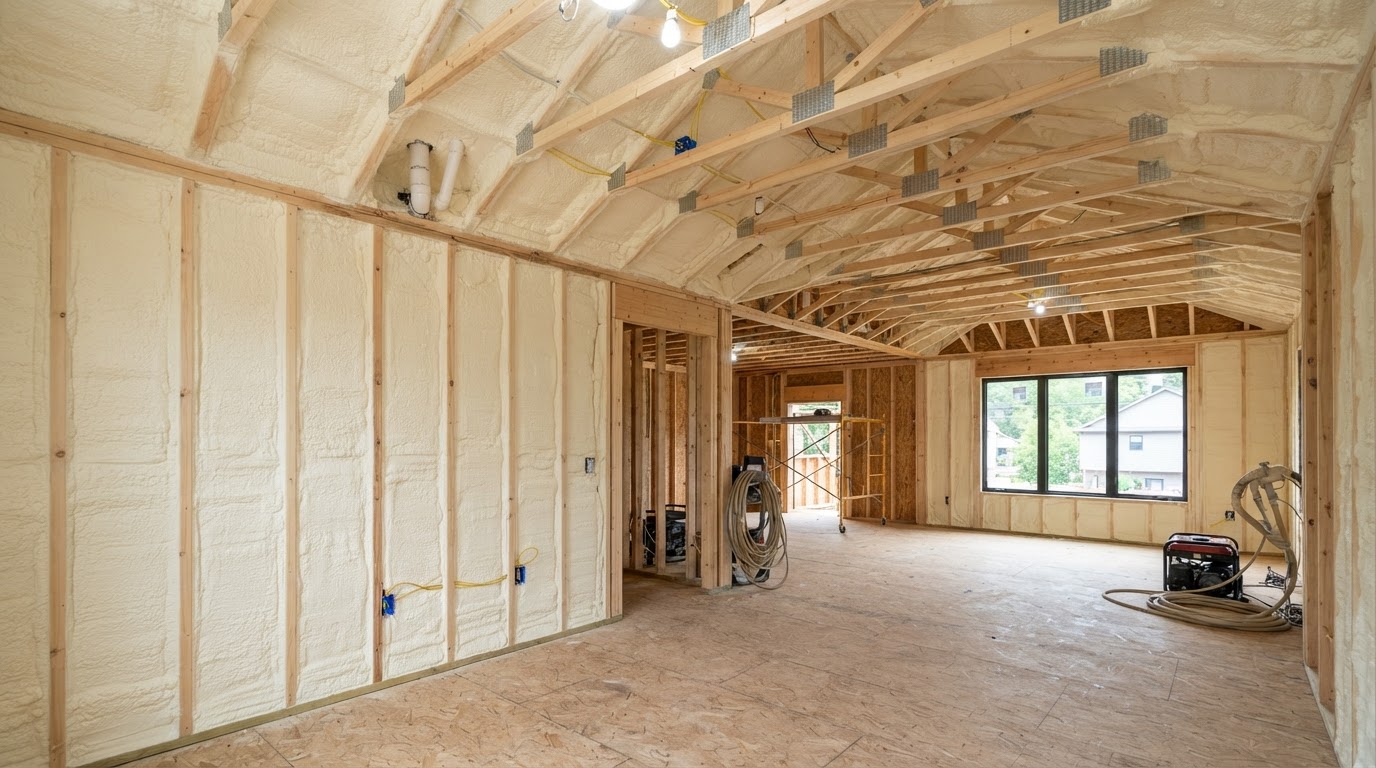
Open Cell vs Closed Cell Spray Foam: What's the Difference?
Last reviewed: November 5, 2026
Open-cell spray foam is lower-density, softer and more vapor permeable. Closed-cell spray foam is denser, more rigid, typically offers greater R-value per inch and generally has lower vapor permeability. Neither product is universally better — the correct choice depends on the assembly, moisture conditions, available depth and project objectives.
Open Cell vs Closed Cell at a Glance
Values are general tendencies; exact performance varies by product and manufacturer.
| Characteristic | Open Cell | Closed Cell |
|---|---|---|
| Cell Structure | Open cellular structure | Closed cellular structure |
| Typical Density | Lower density (~0.5 lb/ft³ class) | Higher density (~2.0 lb/ft³ class) |
| Relative R-Value per Inch | Generally lower per inch | Generally higher per inch |
| Expansion | Greater expansion in place | Less expansion per application |
| Rigidity | Softer, flexible cured material | Rigid cured material |
| Vapor Permeability | Generally more vapor permeable | Generally lower vapor permeability |
| Sound Absorption | Often stronger sound absorption | Less sound absorption in general |
| Material Use | Less material mass per inch | More material mass per inch |
| Cost Tendency | Generally lower for equivalent area | Generally higher for equivalent area |
| Common Framed Applications | Deep walls, rooflines, attics | Limited-depth walls, crawl spaces, rim |
| Common Metal Applications | Framed interior buildouts | Direct-to-panel metal surfaces |
| Limited-Depth Cavities | May need more depth for target R | Higher R per inch in shallow framing |
| Moisture Exposure | Generally not for high-moisture assemblies | Commonly considered where moisture risk is higher |
| Trimming | Often trimmed after deep fills | Less trimming in thin lifts |
| Typical Residential Uses | Attics, rooflines, walls, sound areas | Crawl spaces, rim, limited-depth areas |
| Typical Commercial Uses | Framed walls, rooflines, partitions | Metal buildings, roof decks, masonry-adjacent |
What Is Open Cell Spray Foam?
Open-cell spray foam is a lower-density polyurethane foam with an open cellular structure. It expands more in place, cures into a softer material, is generally more vapor permeable, and is useful in many framed assemblies. It may also contribute to acoustic absorption within some assemblies — but it is not soundproofing.
Open Cell Spray Foam serviceWhat Is Closed Cell Spray Foam?
Closed-cell spray foam is a higher-density foam with a closed cellular structure. It cures into a rigid material, generally offers higher R-value per inch, and has lower vapor permeability in general. It is commonly considered for metal, limited-depth and higher-moisture-risk assemblies depending on design — but it is not waterproof and is not a substitute for waterproofing systems.
Closed Cell Spray Foam serviceWhich Foam Has Better R-Value?
Closed-cell foam generally provides a higher nominal R-value per inch. But correct assembly design and installed thickness matter more than comparing one number in isolation — full-assembly performance depends on framing, thermal bridging, air leakage and continuity.
R-Value & Thickness GuideWhich Foam Is Better for Attics?
It depends on the roof assembly, vented vs unvented design, framing depth, vapor strategy, product and local/project requirements. There is no universal attic winner — open-cell deep fills and closed-cell roofline approaches each suit different assemblies.
Which Foam Is Better for Crawl Spaces?
It depends on whether the strategy insulates the floor system or the crawl-space walls, plus the substrate, moisture, inspection access and vapor characteristics. Do not prescribe open or closed cell universally for crawl spaces — the assembly and moisture strategy drive the decision.
Which Foam Is Better for Metal Buildings?
Closed-cell is commonly considered for qualifying metal surfaces because of its density, rigidity and vapor characteristics. But product selection still depends on the substrate, intended conditioning, condensation strategy, required thickness, interior exposure, cost and project specifications.
Metal Building Spray FoamWhich Foam Is Better for Sound Control?
Open-cell foam often has stronger sound-absorption characteristics because of its softer, open structure. However, sound isolation depends on the complete assembly design — drywall layers, framing, resilient channels, penetrations, doors and ceilings all matter. Neither foam is soundproofing.
Sound Control & Interior Wall Spray FoamWhich Foam Costs More?
Closed-cell foam tends to have a higher installed material cost for equivalent surface area because it is denser and often applied differently. Final project cost depends on thickness, square footage, application, access, preparation and the required thermal target.
Spray Foam Cost GuideCan Open Cell and Closed Cell Be Used on the Same Project?
Potentially yes, where different assemblies call for different materials — for example, one product in framed interior or roof assemblies and another in metal or limited-depth areas. Do not recommend mixing systems without project evaluation.
How to Choose Between Open and Closed Cell
- What is the assembly?
- What substrate receives the foam?
- How much cavity depth is available?
- What thermal target applies?
- Is vapor control important?
- Is the area exposed to moisture?
- Will foam remain exposed?
- Is the substrate metal, wood or masonry?
- Is sound absorption a goal?
- What are the project specifications?
Frequently Asked Questions
What is the main difference between open and closed cell spray foam?
Open-cell foam is lower-density, softer and more vapor permeable; closed-cell foam is denser, more rigid, typically offers greater R-value per inch and generally has lower vapor permeability.
Neither product is universally better. The correct choice depends on the assembly, moisture conditions, available depth and project objectives.
Which spray foam has higher R-value?
Closed-cell foam generally provides a higher nominal R-value per inch than open-cell foam.
But correct assembly design and installed thickness matter more than comparing one number in isolation. See the R-Value & Thickness Guide for detail.
Which spray foam is more expensive?
Closed-cell foam tends to have a higher installed material cost for equivalent surface area because it is denser and often applied differently.
Final project cost depends on thickness, square footage, application, access, preparation and the required thermal target — not material alone.
Which spray foam is better for attics?
It depends on the roof assembly, vented vs unvented design, framing depth, vapor strategy, product and local/project requirements.
There is no universal attic winner. Open-cell deep fills and closed-cell roofline approaches each suit different assemblies.
Which is better for metal buildings?
Closed-cell is commonly considered for qualifying metal surfaces because of its density, rigidity and vapor characteristics.
Product selection still depends on the substrate, intended conditioning, condensation strategy, required thickness, interior exposure, cost and project specifications.
Can open cell absorb moisture?
Open-cell foam is generally more vapor permeable, which means moisture can move through it more readily than through closed-cell foam.
Whether that is appropriate depends on the assembly's moisture strategy. Assembly design and the substrate matter — do not assume either foam is right for every moisture condition.
Is closed cell waterproof?
No. Closed-cell foam should not be marketed as a substitute for roofing, flashing, drainage or foundation waterproofing systems.
Closed-cell foam may have lower vapor permeability at a specified thickness, but it is not a waterproofing layer. Bulk-water and drainage problems must be addressed separately.
Can open and closed cell be used in the same building?
Potentially yes, where different assemblies call for different materials — for example, one product in framed interior or roof assemblies and another in metal or limited-depth areas.
Do not recommend mixing systems without project evaluation. The assembly, substrate and moisture conditions should drive each decision.
Reviewed for project-planning accuracy by Madison Spray Foam Installation · Last reviewed: November 5, 2026
Get Help Choosing the Right Foam
Open cell and closed cell each fit different assemblies. Share your building type, application area and a few project details for a recommendation matched to the assembly.