
Ignition Barriers vs Thermal Barriers for Spray Foam Insulation
Last reviewed: November 5, 2026
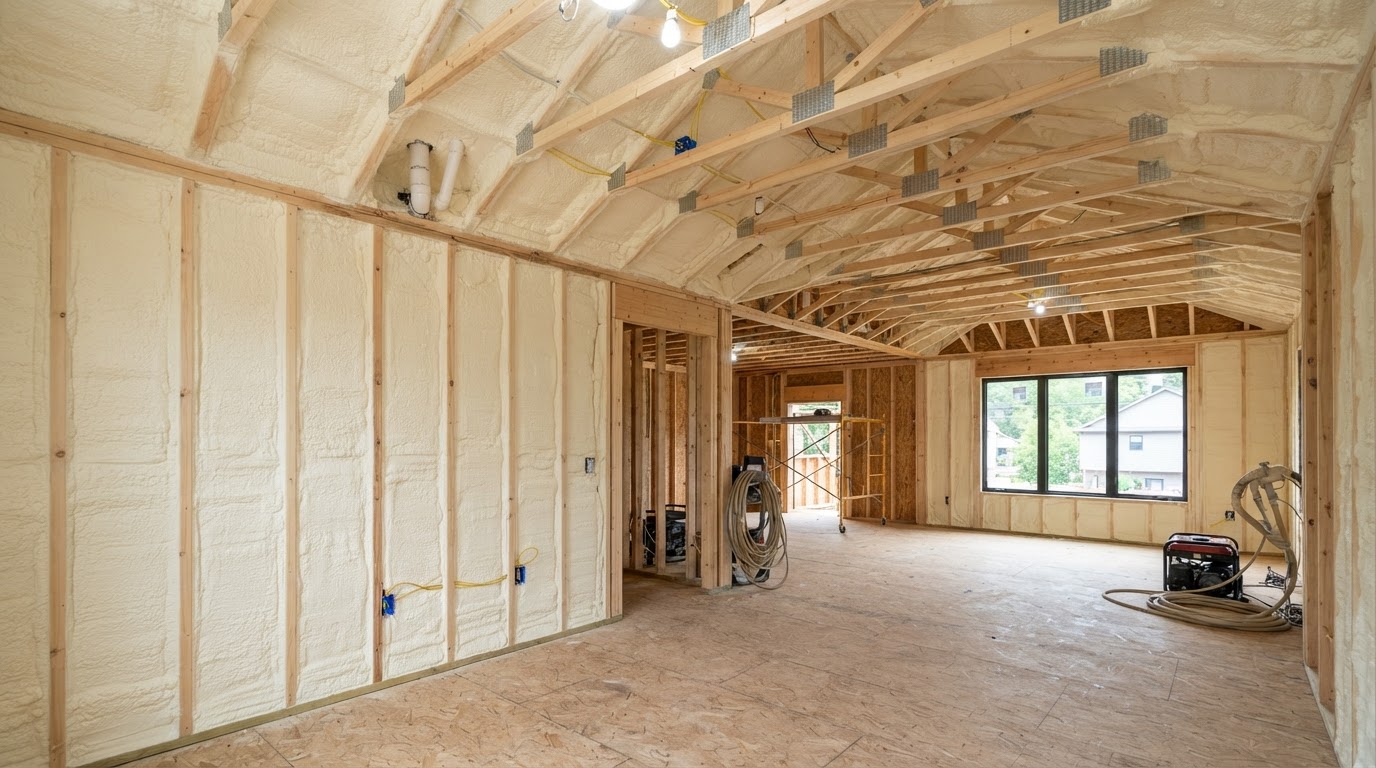
Spray polyurethane foam is classified as a foam-plastic insulation under model building codes and requires separation from occupied building spaces or specific ignition protection in utility areas. A thermal barrier and an ignition barrier are not the same thing. Requirements depend on the building location, space occupancy, applicable code, and the tested assembly documentation of the specific spray foam system.
Thermal Barrier vs Ignition Barrier Comparison
| Feature | Thermal Barrier | Ignition Barrier |
|---|---|---|
| Primary Purpose | Separates foam plastic from occupied space and delays temperature rise during a fire | Prevents direct spark or flame ignition of foam plastic in limited-access spaces |
| Typical Location | Habitable spaces, finished rooms, commercial interiors, attics used for living/storage | Attics and crawl spaces accessible only for service or maintenance utilities |
| Occupied Space Use | Mandatory in all routinely occupied building areas unless specifically exempt | Not sufficient for routinely occupied living areas or storage rooms |
| Common Materials | 1/2-inch gypsum board, 23/32-inch wood structural panel, or tested intumescent coating system | 1.5-inch mineral wool/fiberglass, 1/4-inch plywood/OSB, 3/8-inch gypsum, or approved coating |
| Tested Assembly Exceptions | Requires full-scale fire testing (such as NFPA 286 or UL 1715) for special approvals | Product-specific ICC-ES evaluation reports may list tested assembly exemptions without separate cover |
| Code Verification Needed | Always verify local building code (IRC R316.4 / IBC 2603.4) and evaluation report | Always verify attic/crawl space accessibility status (IRC R316.5.3 / R316.5.4) |
What Is a Thermal Barrier?
A thermal barrier is an approved material intended to separate foam plastic insulation from the interior of a building. Its purpose is to delay the temperature rise of the foam during an interior fire exposure, restricting flame spread and toxic smoke contribution.
Under IRC Section R316.4 and IBC Section 2603.4, a standard thermal barrier must limit temperature rise on the unexposed side to no more than 250°F above ambient for 15 minutes of standard fire exposure. 1/2-inch gypsum wallboard is recognized as a prescriptive thermal barrier without additional testing.
What Is an Ignition Barrier?
An ignition barrier provides a reduced level of fire protection permissible strictly in unoccupied attics and crawl spaces that are accessed only for servicing utilities (such as HVAC units or plumbing).
Under IRC Section R316.5.3 (attics) and R316.5.4 (crawl spaces), approved materials include 1.5-inch mineral fiber insulation, 1/4-inch wood structural panels, 3/8-inch gypsum, or tested liquid-applied coatings. If an attic is used for household storage or living, a full thermal barrier is required instead.
Special Tested Assembly Exemptions
Model building codes allow spray foam to remain exposed in limited-service attics or crawl spaces IF the specific spray foam formulation has passed large-scale fire testing (such as NFPA 286, AC377 Appendix X, or UL 1715) without a separate covering.
These exemptions are product-specific. The installer or builder must provide the ICC-ES or accredited evaluation report for the exact foam formulation to verify that exposed application is code-approved for that specific attic or crawl space configuration.
Fire Protection Verification Checklist
- What specific spray foam product and formulation is being installed?
- Which building code edition governs the project jurisdiction?
- Is the space routinely occupied or used for household storage?
- Is space access strictly limited to utility service and maintenance?
- Is the application in an attic, crawl space, wall cavity, or exposed ceiling?
- Does the spray foam product hold an ICC-ES report with tested assembly approvals?
- Is a liquid-applied intumescent coating specified, and is it tested with that exact foam?
- What do local amendments or the building official require for inspection sign-off?
Frequently Asked Questions
Does spray foam need to be covered?
In most occupied building spaces, yes. Building codes require foam plastic insulation to be separated from interior living space.
Code requires a thermal barrier (such as 1/2-inch gypsum board) between foam plastic and occupied spaces to prevent rapid fire involvement. Exceptions exist in limited-access attics, crawl spaces, or specific tested assemblies.
What is a thermal barrier?
A thermal barrier is a protective covering or coating designed to delay heat transfer into foam plastic during a fire.
Standard thermal barriers include 1/2-inch gypsum wallboard or equivalent tested materials that restrict temperature rise on the unexposed surface of the foam for a prescribed duration (typically 15 minutes in standard test exposure).
What is an ignition barrier?
An ignition barrier is a lesser degree of protection allowed in attics and crawl spaces accessible only for service.
Ignition barriers prevent accidental ignition from sparks or small heat sources in spaces where occupants do not routinely live or store goods, such as unvented attics containing HVAC equipment.
Are ignition and thermal barriers the same?
No. They serve different risk levels and require different performance levels.
A thermal barrier provides higher fire resistance for occupied areas. An ignition barrier provides lower resistance permitted strictly in limited-access utility attics and crawl spaces.
Does attic spray foam need an ignition barrier?
It depends on whether the attic is used for storage/occupancy and whether the foam product has a tested assembly approval.
If an attic is accessed only for servicing mechanical equipment, an ignition barrier or an approved tested foam assembly is required. If used for storage, a full thermal barrier is typically required.
Does crawl-space spray foam need protection?
Yes, unless the crawl space is purely for mechanical service and uses an approved product/assembly.
Exposed foam in crawl spaces accessible for utility servicing requires an ignition barrier unless the specific spray foam product holds a product evaluation report permitting exposed application under IRC R316.5.4 conditions.
Can paint be used over exposed spray foam?
Standard latex paint is NOT an approved thermal or ignition barrier.
Only specially formulated, liquid-applied intumescent coatings that have been tested in combination with that exact spray foam product and applied at specified wet-film thickness qualify as code-compliant barriers.
Does closed-cell foam still need fire protection?
Yes. Both open-cell and closed-cell polyurethane foams are classified as foam plastic insulation under building codes.
While closed-cell foam is denser and more rigid, both open-cell and closed-cell SPF are subject to IRC Section R316 and IBC Section 2603 fire protection requirements.
Technical References
- International Residential Code (IRC) Section R316 — Foam Plastic Insulation
- International Building Code (IBC) Section 2603 — Foam Plastic Insulation
- NFPA 286 / UL 1715 — Standard Methods of Fire Tests for Evaluating Contribution of Wall and Ceiling Coverings to Room Fire Growth
- Spray Polyurethane Foam Alliance (SPFA) Tech Paper AY-126 — Thermal and Ignition Barriers for SPF
Reviewed for project-planning accuracy by Madison Spray Foam Installation · Last reviewed: November 5, 2026
Ensure Code Compliance on Your Project
Fire safety and barrier rules vary by space accessibility and project classification. Contact our team for project guidance or submittal documentation.