
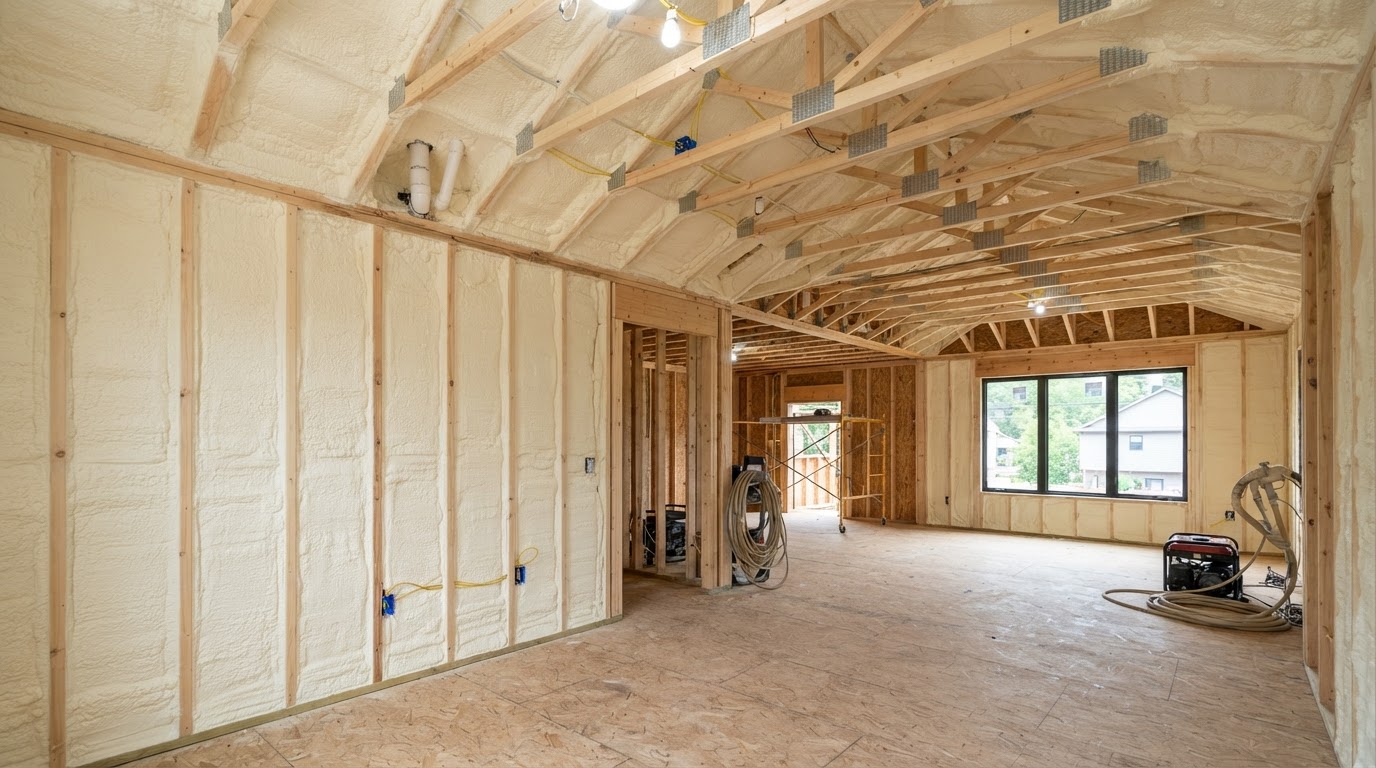
Spray Foam vs Fiberglass vs Cellulose: Which Insulation Makes Sense?
Last reviewed: November 5, 2026
All three insulation types can work well when used in the right assembly. The main differences are not just R-value — air permeability, cavity fit, installation method, moisture behavior, retrofit practicality, cost tendency and assembly compatibility all shape which material fits a given project. The best choice depends on the building assembly, project goals, access and budget.
Quick Comparison: Spray Foam vs Fiberglass vs Cellulose
Neutral, attribute-by-attribute comparison — no oversimplified "winner" badges. Values vary by product, manufacturer and installation.
| Factor | Spray Foam | Fiberglass | Cellulose |
|---|---|---|---|
| Air Sealing | Can function as an air-control material in qualifying assemblies when installed to product requirements | Air permeable; relies on a separate air-sealing strategy at leakage paths | Dense-pack can reduce airflow but is not automatically an air barrier |
| Typical R-Value per Inch | Closed cell higher; open cell lower per inch (varies by product) | Varies by product, density and installation (commonly ~R-2.7 to ~R-4.3) | Varies by product, density and settling (commonly ~R-3.1 to ~R-3.8) |
| Cavity Fit | Expands to fill and conform to irregular geometry | Cut to fit cavities; gaps or compression reduce effectiveness | Blown/dense-packed into cavities; performance depends on fill quality |
| Retrofit Ease | Generally requires cavity access; not every closed wall cavity is accessible | Batt replacement requires open walls; loose-fill for open attics | Dense-pack can retrofit closed wall cavities through small access holes |
| Moisture Sensitivity | Generally tolerates incidental moisture better; not a drainage or waterproofing layer | Air-permeable; can hold moisture if the assembly is wet; drying strategy matters | Can absorb moisture; drying potential and source control matter |
| Vapor Permeability | Closed cell lower permeability; open cell higher — varies by product/thickness | Vapor permeable; assembly design determines vapor strategy | Vapor permeable; can store and release moisture depending on conditions |
| Sound Absorption | Open cell can contribute to sound absorption in some assemblies | Good sound absorption in many framed assemblies | Dense fill can help reduce sound transmission through cavities |
| Installation Complexity | Specialized application equipment and trained installers | Commonly installed; quality sensitive to workmanship and fit | Requires proper equipment and technique for dense-pack; settling matters |
| Relative Cost Tendency | Often higher installed cost; may combine thermal and air-control functions | Often lower upfront material cost | Often moderate depending on application and density |
| Common Attic Use | Roofline / unvented attic assemblies | Vented attic floor; batts or loose-fill | Loose-fill attic floor; dense-pack in retrofit walls |
| Common Wall Use | Open wall cavities; exterior walls during construction | Wall cavities; batts during construction or renovation | Retrofit wall cavities (dense-pack); attic floors (loose-fill) |
| Common Crawl Space Use | Floor-joist or perimeter-wall assemblies where appropriate | Floor-joist batts; moisture conditions must be addressed first | Less common in crawl spaces; moisture concerns with fibrous fills |
| Metal Building Use | Can conform directly to qualifying metal surfaces | Liner-system or batt approaches depending on building design | Less common in metal-building envelope applications |
What Is Spray Foam Insulation?
Spray polyurethane foam is a two-component material that is sprayed onto a substrate and expands on application. It is available in open-cell and closed-cell formulations, which differ in density, rigidity, vapor characteristics and R-value per inch. In qualifying assemblies, spray foam can provide both thermal insulation and a degree of air control when installed to product-specific requirements.
What Is Fiberglass Insulation?
Fiberglass insulation is available in batts, rolls and loose-fill (blown) forms. It is widely available and often has a lower upfront material cost. Because it is air permeable, fiberglass relies on a separate air-control strategy at leakage pathways. Performance is sensitive to installation quality — gaps, voids and compression can reduce effectiveness. Fiberglass can perform effectively when properly installed and paired with a suitable air-control strategy.
What Is Cellulose Insulation?
Cellulose insulation is commonly made from recycled paper fiber and is installed as loose-fill or dense-pack. It is often used in attics and retrofit wall cavities. Dense-pack cellulose can reduce airflow more than loosely installed fibrous materials, but it is not automatically an air barrier and still relies on the surrounding assembly for air and moisture control. Settling and installation technique are considerations.
Which Insulation Air-Seals Best?
Spray foam can function as an air-control material in qualifying applications when installed to product-specific requirements. Fiberglass and cellulose typically require a separate air-sealing strategy at leakage pathways such as top plates, penetrations and rim areas. Insulation and air sealing are related but not identical — adding insulation does not automatically address uncontrolled air movement.
Attic Air SealingWhich Has the Highest R-Value per Inch?
Closed-cell spray foam generally has a higher R-value per inch than the other materials discussed here. Open-cell spray foam is lower per inch than closed cell. Fiberglass and cellulose values vary by product and density. R-value per inch alone does not describe whole-assembly performance — framing, thermal bridging, air leakage and continuity all matter.
R-Value & Thickness GuideWhich Is Better for Attics?
It depends on the attic assembly. In a vented attic, fiberglass, cellulose or other floor insulation may be appropriate when air sealing and ventilation are handled correctly. In an unvented roofline assembly, spray foam may be considered as part of the assembly. The right approach is not automatic — it depends on the roof assembly, HVAC location, moisture strategy and applicable requirements.
Which Is Better for Existing Wall Retrofits?
Access drives the decision. Dense-pack cellulose can retrofit closed wall cavities through small access holes, and batt replacement is possible during renovation when cavities are opened. Standard spray polyurethane foam usually requires cavity access and should not be assumed to install into every closed wall cavity unless a specific verified injection product or service is used. Finished wall access, cavity depth and the renovation scope all determine what is practical.
Which Is Better for Crawl Spaces?
The choice depends on whether the crawl space is insulated at the floor system or at the perimeter walls, plus moisture conditions, ground vapor control and access. Fiberglass between floor joists can hold moisture if the crawl space is damp, so moisture should be addressed before any floor insulation is installed. Spray foam may be used in qualifying floor-joist or perimeter-wall assemblies. The decision is assembly-specific.
Which Is Better for Metal Buildings?
Both fibrous insulation systems and spray foam can be used in metal buildings depending on the building design, condensation strategy, liner systems and retrofit conditions. Spray foam can conform directly to qualifying metal surfaces, which can be useful where irregular geometry or condensation-control considerations are present. It should not be presented as the only solution — the building's conditioning, condensation strategy and target insulation value drive the choice.
Metal Building Spray FoamCost Differences
- Fiberglass: Often the lower upfront material cost; performance depends on installation quality and a suitable air-control strategy.
- Cellulose: Often a moderate installed cost depending on application and density; dense-pack adds equipment and technique considerations.
- Spray foam: Often a higher installed cost, but may combine thermal insulation with a degree of air control in qualifying assemblies, which can affect project scope.
How to Choose
- 1What assembly is being insulated?
- 2Is air sealing a major project goal?
- 3Is the space open framing or finished?
- 4Is moisture exposure present that must be addressed first?
- 5How much cavity depth is available?
- 6Is the project new construction or a retrofit?
- 7Is the substrate metal, wood or masonry?
- 8What is the project budget?
- 9What insulation level is required by the project or applicable requirements?
Frequently Asked Questions
Is spray foam better than fiberglass?
Not automatically. Each material can perform well in the right assembly.
Spray foam can combine insulation and a degree of air control in qualifying applications, while fiberglass can perform effectively when properly installed and paired with a suitable air-control strategy. The right choice depends on the assembly, access, budget and project goals.
Is cellulose better than fiberglass?
Neither is universally better — it depends on the application.
Dense-pack cellulose can reduce airflow more than loosely installed fibrous materials, while fiberglass is widely available and often lower cost. Retrofit wall access, moisture conditions and installation quality all affect which fits the project.
Which insulation air seals best?
Spray foam can function as an air-control material in qualifying assemblies when installed to product-specific requirements.
Fiberglass and cellulose typically require a separate air-sealing strategy at leakage pathways. Insulation and air sealing are related but not identical.
Which insulation has the highest R-value?
Closed-cell spray foam generally has the highest R-value per inch of the materials discussed.
Open-cell spray foam is lower per inch than closed cell, and fiberglass and cellulose values vary by product and density. R-value per inch alone does not describe whole-assembly performance.
Which insulation is best for attics?
It depends on the attic assembly — vented floor versus unvented roofline.
In a vented attic, fiberglass, cellulose or other floor insulation may be appropriate when air sealing and ventilation are handled correctly. In an unvented roofline assembly, spray foam may be considered as part of the assembly.
Which is best for existing walls?
Access drives the decision for finished walls.
Dense-pack cellulose can retrofit closed wall cavities through small access holes, and batt replacement is possible during renovation when cavities are opened. Standard spray polyurethane foam usually requires cavity access unless a verified injection product or service is used.
Which is best for metal buildings?
Both fibrous systems and spray foam can be used depending on the building design and condensation strategy.
Spray foam can conform directly to qualifying metal surfaces, which can help with irregular geometry and condensation control. It should not be presented as the only solution — the building's conditioning and target insulation value drive the choice.
Which insulation costs the most?
Spray foam often has the highest installed cost of the three.
Fiberglass is often the lower upfront material cost, and cellulose is often moderate depending on application. Spray foam may combine thermal insulation with a degree of air control, which can affect overall project scope.
Technical References
- U.S. Department of Energy — Insulation materials and thermal resistance (general reference for R-value as a measure of thermal resistance).
- Building America Solution Center / PNNL — Attic and crawl-space insulation, air sealing and thermal-boundary guidance.
- Spray foam manufacturer technical data sheets and product evaluation reports — product-specific R-value, density, vapor permeability and air-barrier thickness requirements vary by product.
Reviewed for project-planning accuracy by Madison Spray Foam Installation · Last reviewed: November 5, 2026
Compare Options for Your Project
The right material depends on your assembly, access, budget and goals. Share your project details for a meaningful evaluation rather than relying on a generic comparison.