
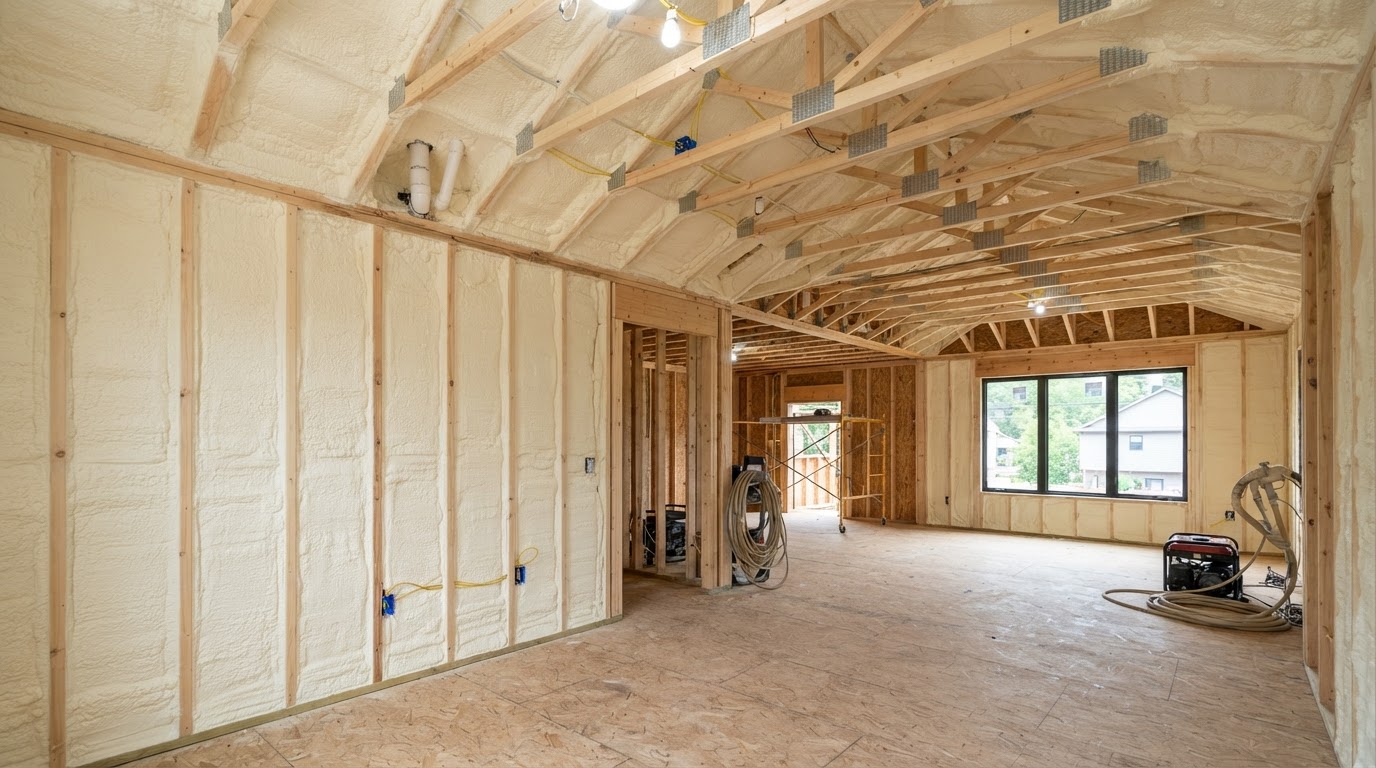
Metal Building Condensation: Can Spray Foam Help?
Last reviewed: November 5, 2026
Metal building condensation occurs when a metal roof or wall panel becomes colder than the dew point of surrounding moisture-bearing interior air. Spray foam may help by insulating qualifying metal surfaces and reducing direct moist air contact with them, but indoor humidity, ventilation, HVAC operation, leaks, and building use also affect condensation.
Why Do Metal Buildings Sweat?
Metal panels and steel framing possess high thermal conductivity. During cold weather or overnight radiant cooling, uninsulated metal panels drop in temperature rapidly.
Condensation forms when three conditions converge:
- Moisture is present in the indoor air (water vapor).
- A metal surface drops below the dew point temperature of that air.
- Moist indoor air makes direct contact with that cold metal surface.
Understanding Dew Point & Air Contact
Dew point is the temperature at which air becomes saturated with water vapor and can no longer hold it in gaseous form, forcing moisture to condense into liquid water.
The Role of Spray Polyurethane Foam
When spray foam is applied directly to clean metal panels, it serves two functions: it creates a thermal break that keeps the interior surface above dew point temperatures, and it adheres monolithically to eliminate the air gap where humid air could otherwise reach cold metal.
What Spray Foam Cannot Fix by Itself
Insulation is a thermal and air-barrier component, not a substitute for moisture management or roof maintenance.
Exterior Roof Leaks
Bulk rainwater penetrating roof panel laps, degraded fasteners, or damaged flashing must be repaired externally.
Excessive Indoor Relative Humidity
Unvented gas heaters, vehicle washdowns, wet concrete slabs, or industrial steam generation require source exhaust or dehumidification.
Corroded or Scaled Metal Substrates
Heavy rust and loose scale compromise foam adhesion and must be cleaned or repaired prior to spraying.
Inadequate Ventilation Strategy
Unconditioned metal buildings with high occupancy or animal housing require balanced air turnover alongside insulation.
Condensation vs Roof Leak: How to Tell
Condensation
Typically occurs widespread across whole roof/wall panels during sudden temperature drops, high indoor humidity, or clear cold nights, even when there is no rain outside.
Roof Leak
Appears at specific locations (fasteners, ridge caps, wall transitions, seams) directly corresponding to rainstorms, wind-driven rain, or melting ice accumulation.
Pre-Insulation Metal Building Checklist
- Is the metal roof or wall panel currently leaking from exterior rainwater?
- Are metal surfaces clean, dry, and free of active rust or unbonded scale?
- Are existing coatings on the metal panels compatible with spray foam adhesion?
- Is condensation actively forming during specific outdoor weather conditions?
- What is the building used for, and are there internal moisture-generating processes?
- Is the space fully conditioned, semi-conditioned, or unconditioned?
- What ventilation or exhaust systems are currently operating in the building?
- Is existing vinyl-faced fiberglass insulation wet, sagging, or deteriorating?
- Which spray foam product formulation is planned for the metal panels?
- Will the installed spray foam require a protective fire barrier under applicable code?
Frequently Asked Questions
Why does my metal building sweat?
Metal building condensation occurs when indoor moisture-bearing air contacts metal surfaces cooled below the air's dew point.
Steel panels and structural framing conduct cold efficiently. When warm, humid indoor air hits these cold metal surfaces, water vapor condenses into liquid droplets, creating the sweating effect.
What is dew point?
Dew point is the temperature at which air becomes saturated with water vapor and moisture begins to condense into liquid.
If the interior surface temperature of a metal roof panel drops below the dew point of the surrounding air, condensation will form regardless of total room temperature.
Can spray foam stop condensation on a metal roof?
Spray foam can help reduce condensation by insulating metal surfaces and limiting direct moist air contact with cold panels.
When directly applied to qualifying clean metal substrates, spray foam keeps the interior face above dew point temperatures and restricts air movement against the metal. Overall humidity and leaks must still be managed.
Is condensation the same as a roof leak?
No. Condensation is interior moisture turning into water droplets, while a leak is exterior rainwater penetrating the roof.
Distinguishing between condensation and rainwater leakage is critical. Spray foam insulation insulates and seals against air leakage, but it does not replace exterior roof repairs or flashing fixes.
Is closed-cell spray foam better for metal buildings?
Closed-cell spray foam is frequently evaluated for metal buildings due to its density, rigidity, high R-value per inch, and low vapor permeance.
Closed-cell foam adheres firmly to metal panels, adds structural rigidity, and restricts moisture migration. Open-cell foam may be considered in specific framed or controlled-humidity assemblies.
Can existing fiberglass cause condensation problems?
If vinyl-faced fiberglass insulation sags, tears, or leaves air gaps against metal panels, moist air can enter behind it.
Humid air passing through gaps in fiberglass contacts the cold metal roof, condenses, and becomes trapped, causing wet insulation, dripping, and panel corrosion risks.
Can spray foam be installed over rusty metal?
Loose rust, heavy scaling, and severe structural corrosion must be treated or repaired before spray foam is applied.
Proper surface preparation is required for spray foam adhesion. Severe rust compromises the substrate and must be addressed prior to insulation work.
Will insulation alone control humidity?
No. Insulation affects thermal transfer and air contact, but it does not remove moisture from the air.
Controlling high indoor humidity requires proper ventilation, mechanical dehumidification, source moisture control, and proper building use alongside insulation.
Technical References
- U.S. Department of Energy (DOE) Building America — Moisture & Condensation Control in Metal Buildings
- Pacific Northwest National Laboratory (PNNL) — Building Envelope Thermal & Dew Point Analysis
- Metal Building Manufacturers Association (MBMA) Energy Design Guide — Insulation & Condensation Management
- Spray Polyurethane Foam Alliance (SPFA) Tech Paper AY-118 — SPF Applications for Metal Buildings
Reviewed for project-planning accuracy by Madison Spray Foam Installation · Last reviewed: November 5, 2026
Evaluate Your Metal Building Project
Whether you have a commercial warehouse in Huntsville, a shop building in Madison, or an agricultural barn, we can evaluate your metal structure and moisture strategy.