
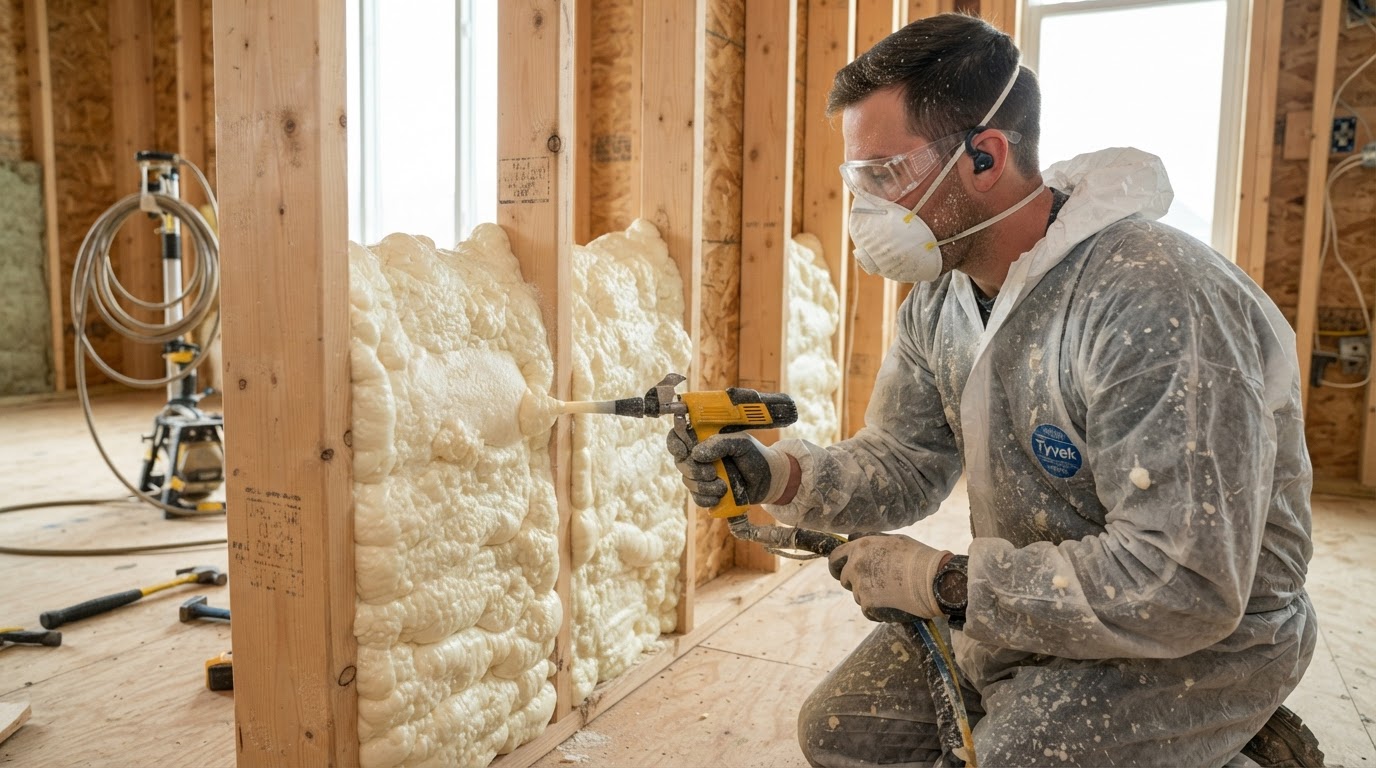
Open Cell Spray Foam Insulation in Madison, AL
Open-cell spray foam insulation in Madison, AL is a lower-density spray polyurethane foam that expands significantly on application to fill deep framing cavities and provide air sealing. Madison Spray Foam Installation applies open-cell SPF for residential attics, roof decks, and interior wall cavities for new construction and retrofit projects throughout Madison, Alabama and surrounding North Alabama communities.
Open-cell foam is not a universal solution, and it is not automatically the cheaper or better choice for every assembly. It performs well in specific applications—particularly interior residential assemblies with deep framing—but the right material depends on the building assembly, moisture exposure, and project goals.
To discuss whether open-cell foam fits your project, request an estimate or call (256) 387-9068. We evaluate the assembly before recommending a material.
Understanding Open Cell Spray Foam Insulation
Open-cell spray foam is named for its cellular structure: the cells are left open during expansion, producing a softer, lighter, flexible material that expands many times its liquid volume. That high expansion lets it fill deep framing cavities and conform to irregular geometry, which is useful in residential attics and walls.
Because it is vapor permeable, open-cell foam allows moisture to pass through it rather than blocking it. This can be an advantage in assemblies where you want to detect a roof leak, and it makes material selection dependent on the assembly's moisture dynamics. Open-cell is commonly used in interior, climate-controlled assemblies rather than in direct contact with moisture-prone surfaces.
Compared to closed-cell foam, open-cell is lower density and softer, expands more, and is vapor permeable. The choice between the two is an assembly decision, not a simple preference—see our Closed Cell Spray Foam Insulation page for the comparison.
Characteristics & Considerations for Open Cell Foam
Open-cell foam is chosen for its high expansion, air sealing, and suitability for interior residential assemblies. The points below describe its general characteristics; the right material depends on the specific assembly and project goals.
Air Sealing
Expands to fill deep cavities and seal gaps, joints, and penetrations as an air barrier.
Fills Deep Cavities
High expansion fills 2x4, 2x6, and deeper rafter cavities completely.
Sound Dampening
Soft, flexible structure can help reduce sound transmission between interior spaces.
Vapor Permeable
Allows moisture to pass through, which can aid leak detection in suitable assemblies.
Open-cell foam is vapor permeable, so it is not the right choice for every assembly—particularly those in direct contact with moisture-prone surfaces or where a vapor retarder is required. We do not state universal R-values without qualifying by product and thickness, and we do not claim open-cell is always better or cheaper than closed-cell.
Deciding When Open Cell Spray Foam Is Appropriate
Choosing open-cell foam is an assembly decision. The steps below reflect how we evaluate whether open-cell is the right material for a given project.
Review the Assembly
We assess the framing depth, the assembly location, and whether the space is climate-controlled.
Evaluate Moisture Exposure
We determine whether the assembly's moisture dynamics suit a vapor-permeable material.
Compare With Closed Cell
We weigh open-cell against closed-cell for the specific assembly and project goals.
Specify Thickness
We recommend a target thickness appropriate to the product and assembly.
Prepare & Apply
We protect adjacent areas and apply open-cell foam in controlled passes.
Inspect & Finish
We verify coverage and trim where drywall will follow the cavity.
For the direct comparison, see our Closed Cell Spray Foam Insulation page. For common applications, see our Attic Spray Foam Insulation and Residential Spray Foam Insulation pages.
Open Cell Spray Foam Insulation Near Madison and North Alabama
Madison Spray Foam Installation applies open-cell spray foam insulation for residential projects in Madison, AL 35758 and surrounding North Alabama communities. Our approach is to match the material to the assembly, not to default to a single product.
We help property owners understand why open-cell suits certain assemblies and where closed-cell would be a better fit. That includes explaining vapor permeance, expansion, and the framing depth each material works best with.
If you are deciding between materials, the related service pages below offer the comparison and application detail you need.
Open Cell Spray Foam Insulation FAQs
What is open cell spray foam?
Open-cell spray foam is a lower-density spray polyurethane foam whose cells are left open during expansion, producing a soft, flexible, highly expansive material.
It expands to fill deep framing cavities and is vapor permeable. It is commonly used in interior residential assemblies like attics and walls.
Where is open cell spray foam commonly used?
Open-cell foam is commonly used in unvented residential roof decks, interior wall cavities, and acoustic walls where vapor permeability is acceptable.
It works best in climate-controlled interior assemblies with deep framing. It is generally not the first choice for surfaces in direct contact with moisture-prone environments.
Is open cell spray foam good for attics?
Yes, open-cell foam is commonly applied to residential roof decks because its high expansion fills deep rafter cavities effectively.
Its vapor permeability can aid leak detection in some assemblies. Whether it is the right choice for your attic depends on the roof assembly and goals.
Can open cell foam be used in walls?
Yes, open-cell foam can be used in interior wall cavities in climate-controlled spaces where vapor permeability is acceptable.
It fills standard framed cavities and can help dampen sound between rooms. We confirm the assembly's moisture dynamics before recommending it for a wall.
Does open cell spray foam air seal?
Yes, open-cell foam functions as an air barrier at full cavity depth, sealing gaps, joints, and penetrations as it expands.
Air sealing is one of the main reasons it is chosen for residential attics and walls. Performance depends on proper installation and the assembly.
What is the difference between open cell and closed cell?
Open-cell is lower density, softer, more expansive, and vapor permeable; closed-cell is denser, more rigid, and can act as a vapor retarder at a specified thickness.
Open-cell suits interior residential assemblies with deep framing; closed-cell is often chosen for metal buildings, crawl spaces, and moisture-prone areas. See our Closed Cell page for the full comparison.
How do I know whether open cell is appropriate?
Open-cell is appropriate when the assembly is interior and climate-controlled, has deep framing, and tolerates a vapor-permeable material.
We evaluate the assembly's moisture dynamics, framing depth, and goals before recommending open-cell or closed-cell foam for your project.
Related Spray Foam Services
Get an Open Cell Spray Foam Estimate
Tell us about your assembly and goals. We will evaluate whether open-cell foam is the right material and recommend an approach for your Madison-area project.