
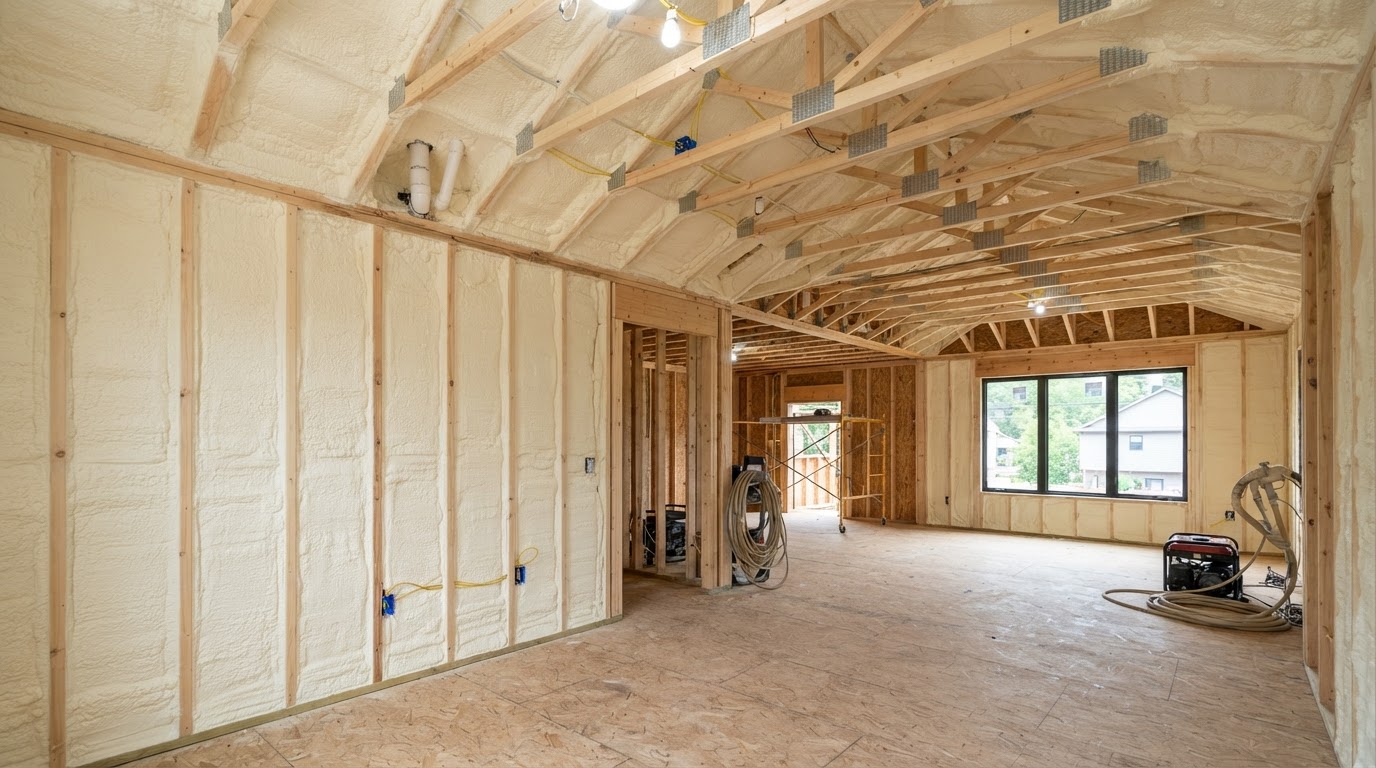
Spray Foam R-Value & Thickness Guide
Last reviewed: November 5, 2026
Spray foam R-value describes thermal resistance, but the exact R-value per inch varies by foam formulation and manufacturer. Open-cell and closed-cell foams typically have different R-value ranges, and no single number applies to all products. Use manufacturer technical data for specific values, and treat R-value as one part of full-assembly performance.
What Is R-Value?
R-value is a standardized measure of a material's resistance to heat flow. Higher R-value means greater resistance to heat transfer under the standardized test conditions used to rate the material.
Important: R-value alone does not describe air leakage, moisture control, thermal bridging, installation quality or full-assembly performance. A material's nominal R-value is one input into the performance of the complete assembly — not the whole story.
Typical Open Cell vs Closed Cell R-Value
These are commonly cited ranges, not universal values. Exact R-value, density and performance vary by product, formulation and manufacturer.
| Foam Type | Typical Density | Typical R-Value Range per Inch | General Characteristics |
|---|---|---|---|
| Open Cell | Lower density (commonly ~0.5 lb/ft³ class) | Commonly cited around R-3.6–3.8 per inch | Softer, more vapor permeable, expands to fill deep framing |
| Closed Cell | Higher density (commonly ~2.0 lb/ft³ class) | Commonly cited around R-6.0–6.5 per inch | Rigid, lower vapor permeability, higher R-value per inch |
Note: Exact values vary by product. Always use the technical data for the specific foam being installed.
How Thickness Affects Nominal R-Value
For a clearly labeled hypothetical product, thickness scales nominal R-value. Example only: if a specific foam is rated R-6.5 per inch, 2 inches would have a nominal product R-value of approximately R-13 before considering the rest of the assembly. Do not assume all closed-cell foam is exactly R-6.5 — use the specific product's data.
Why More Thickness Is Not the Only Question
- Correct thermal boundary location
- Air leakage and continuity
- Available cavity depth
- Roof and wall assembly design
- Vapor control strategy
- Thermal bridging through framing
- Applicable code requirements
- Product limitations and maximum thickness
Thicker is not automatically better — match the thickness to what the assembly actually requires.
Air Barrier Thickness vs Thermal Thickness
Some spray foam products qualify as air-impermeable or air-barrier materials at product-specific minimum thicknesses — and those thicknesses may differ from the thickness required to meet a thermal target. Refer to the specific product's technical documentation and evaluation report. There is no single universal air-barrier thickness.
Vapor Retarder Thickness
Closed-cell products may achieve specific vapor-permeance classifications at certain product-specific thicknesses. Vapor performance depends on the specific product and installed thickness — do not assume 2 inches is always a vapor barrier. Open-cell foam is generally more vapor permeable. Use product data for exact vapor-performance claims.
Common Assemblies & Thickness Questions
| Assembly | Main Design Questions |
|---|---|
| Attic Roofline | Vented or unvented? Framing depth? Required R-value? HVAC location? Product and code requirements? |
| Exterior Wall | Cavity depth? Required R-value? Vapor strategy? Substrate? Interior exposure? |
| Metal Building | Panel substrate? Condensation strategy? Required thickness? Interior exposure? Foam type? |
| Crawl Space Wall | Wall vs floor strategy? Moisture conditions? Inspection access? Vapor characteristics? |
| Floor System | Joist depth? Required R-value? Moisture exposure? Ventilation strategy? |
| Vaulted Ceiling | Limited depth? Vented or unvented? Required R-value? Product? |
| Commercial Roof Deck | Substrate? Interior exposure? Fire/thermal protection? Required R-value? Assembly design? |
R-Value in Metal Buildings
Metal framing and panels can create conductive pathways. Spray foam can add continuous contact insulation to qualifying surfaces, but full-assembly performance depends on framing, thickness, thermal bridges, doors, roof-to-wall transitions and air leakage.
Metal Building Spray FoamR-Value in Attics & Rooflines
Roofline insulation decisions depend on vented vs unvented design, the roof deck, framing depth, product, climate and code requirements, and HVAC location. The right approach is assembly-specific.
How to Determine the Right Thickness
- 1Identify the assembly being insulated.
- 2Identify the thermal boundary location.
- 3Determine the applicable insulation requirement.
- 4Identify the specific foam product.
- 5Check the product's R-value per inch.
- 6Check the product's air and vapor characteristics.
- 7Consider cavity depth and substrate.
- 8Confirm project-specific requirements and any protective barriers.
Frequently Asked Questions
What is the R-value of spray foam?
R-value describes thermal resistance, but exact R-value per inch varies by foam formulation and manufacturer.
Open-cell and closed-cell foams typically have different R-value ranges. Always use the technical data for the specific product being installed rather than a single generic number.
Which has a higher R-value, open cell or closed cell?
Closed-cell foam generally provides a higher nominal R-value per inch than open-cell foam.
But correct assembly design and installed thickness matter more than comparing one number in isolation. Full-assembly performance depends on more than the foam's nominal R-value.
How thick should spray foam be?
Thickness depends on the assembly, the applicable insulation requirement, the specific product and the available cavity depth.
There is no single universal thickness. The right depth matches the thermal and air-control objectives of the assembly without over-application.
Does doubling thickness double nominal R-value?
For a given product, nominal R-value scales roughly with thickness — so doubling thickness can roughly double the nominal product R-value.
This is a nominal product value. Full-assembly thermal performance also depends on framing, thermal bridging, air leakage and continuity.
What thickness creates an air barrier?
Some spray foam products qualify as air-impermeable or air-barrier materials at product-specific minimum thicknesses, which may differ from the thermal thickness.
Air-barrier qualification depends on the specific product and its evaluation report. Refer to the product's technical documentation rather than assuming one universal thickness.
Is closed-cell spray foam a vapor barrier?
Closed-cell products may achieve specific vapor-permeance classifications at certain product-specific thicknesses — but vapor performance depends on the specific product and installed thickness.
Do not assume a single thickness is universally a vapor barrier. Open-cell foam is generally more vapor permeable. Use product data for exact vapor-performance claims.
Does R-value account for air leakage?
No. R-value measures thermal resistance under standardized conditions and does not describe air leakage, moisture control, thermal bridging or installation quality.
A well-insulated assembly with uncontrolled air leakage may underperform its nominal R-value. Air sealing and assembly continuity matter alongside R-value.
How do I know the required insulation level for my project?
The applicable requirement depends on the building type, assembly, jurisdiction and project specifications.
Confirm the required R-value against the applicable code, project specifications and product evaluation report. The checklist below helps frame the decision.
Reviewed for project-planning accuracy by Madison Spray Foam Installation · Last reviewed: November 5, 2026
Request an Insulation Evaluation
The right thickness depends on your assembly, product and project requirements. Share your project details for a meaningful evaluation rather than relying on a generic number.