
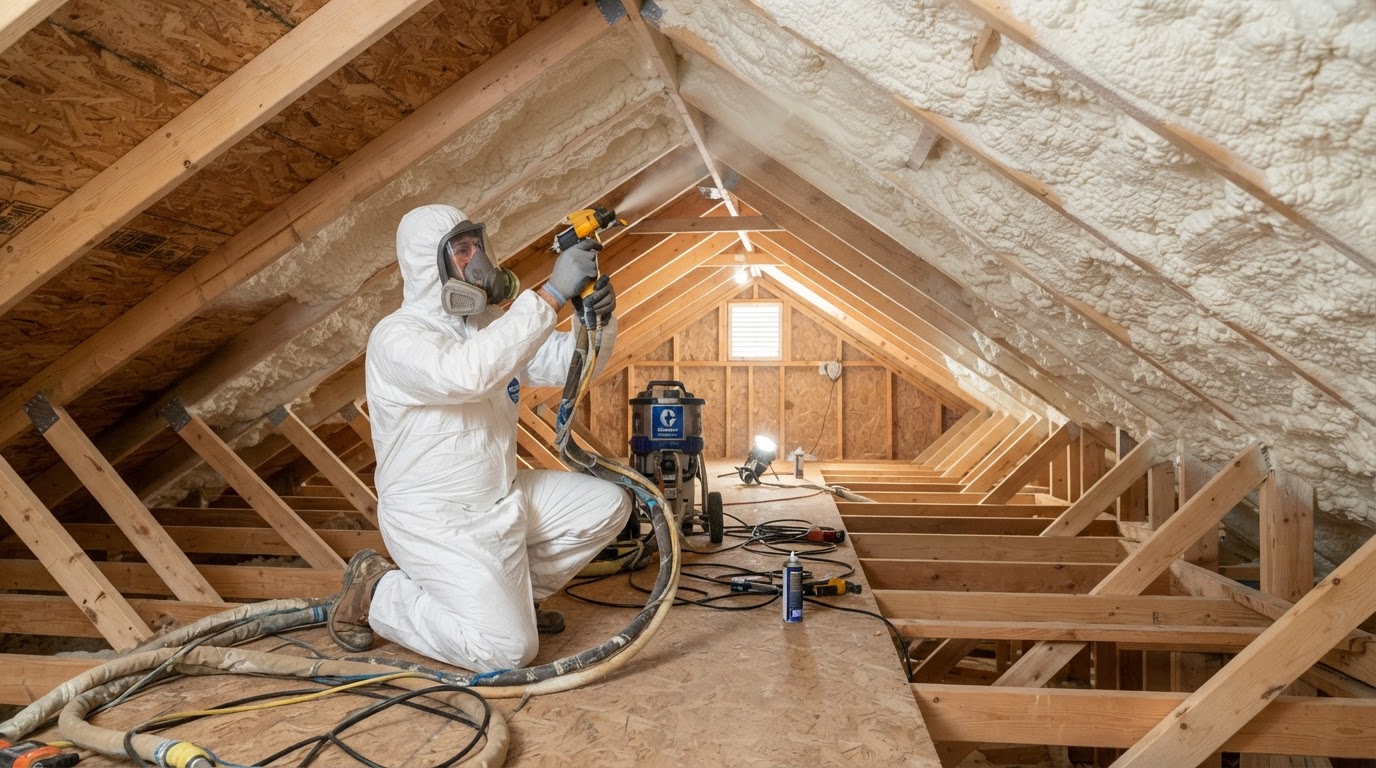
Attic Spray Foam Insulation in Madison, Alabama
Attic spray foam insulation in Madison, Alabama is the application of spray polyurethane foam to an attic assembly—most commonly the underside of the roof deck and rafters—to create a continuous insulating air barrier above the living space. Madison Spray Foam Installation applies open-cell and closed-cell SPF for new construction attics and existing-home attic retrofits throughout Madison, Alabama and surrounding North Alabama communities.
The right attic insulation strategy depends on the roof and ceiling assembly and the project conditions. Not every attic should be spray foamed at the roof deck; the correct approach is driven by the assembly, the HVAC layout, and the owner's goals. We assess the attic before recommending where and how to insulate it.
To discuss your attic, request an estimate or call (256) 387-9068. We evaluate the roof assembly and explain the options that fit your home.
How Attic Spray Foam Insulation Works
A traditional vented attic places insulation on the attic floor—the ceiling drywall of the rooms below—leaving the attic itself outside the conditioned envelope. Spray foam applied to the underside of the roof deck instead brings the attic inside the conditioned space, which can place ductwork and air handlers in a more moderate zone rather than in extreme attic heat.
In a conditioned unvented attic, the foam forms a continuous layer against the roof deck, sealing the gaps, framing intersections, and penetrations that allow uncontrolled air movement. During North Alabama summers, roof decks can reach extreme temperatures; insulating at the roofline addresses that heat before it reaches the living space.
Whether the attic floor or the roof deck is the right place to insulate depends on the assembly. Homes with HVAC equipment in the attic often benefit from a conditioned attic, while other configurations may be better served differently. An assessment determines the appropriate strategy.
Benefits & Considerations for Attic Spray Foam
Attic spray foam is often chosen to bring the attic into the conditioned envelope and to seal the air leaks at the roofline. The benefits below describe what is generally achievable when properly specified and installed; results vary by home and assembly.
Roofline Thermal Control
Insulates at the roof deck to address extreme attic heat before it reaches the living space.
Attic Air Sealing
Seals penetrations, framing intersections, and gaps that allow uncontrolled air movement through the roof assembly.
Ductwork in Conditioned Space
Can place attic ductwork and air handlers inside a more moderate zone rather than in extreme heat.
Continuous Coverage
Conforms to rafters, trusses, and irregular roof geometry that batts cannot seal effectively.
We do not universally recommend spray foaming every attic roof deck. The appropriate strategy depends on the roof and ceiling assembly, HVAC layout, ventilation design, and project goals. Where existing moisture or ventilation problems exist, those may need to be addressed separately from insulation.
Attic Floor vs. Roof Deck: Planning Your Attic Project
Deciding where to insulate an attic is the key decision. The steps below reflect how we evaluate and plan an attic spray foam project in the Madison area.
Review the Attic Assembly
We inspect the roof structure, ceiling assembly, HVAC location, and current insulation.
Assess Ventilation & Moisture
We check venting, existing moisture signs, and whether a conditioned attic is appropriate.
Recommend an Insulation Strategy
We recommend roof-deck foam, attic-floor work, or another approach based on the assembly.
Select Foam Type & Thickness
Open-cell is common for roof decks; we specify thickness based on the assembly and goals.
Prepare the Attic
We address existing insulation, protect mechanicals, and verify substrates are suitable.
Apply & Inspect
Foam is applied to the agreed surfaces and inspected for coverage and depth.
For new homes, see our New Construction Spray Foam Insulation page. For existing homes, see our Existing Home & Retrofit Spray Foam Insulation page.
Attic Spray Foam Contractor Near Madison, Alabama
Madison Spray Foam Installation provides attic spray foam insulation for homes in Madison, AL 35758 and surrounding North Alabama communities. Our approach focuses on understanding the roof assembly before recommending a strategy, and on clear communication about preparation and expectations.
Because attics vary so much, we evaluate each one rather than applying a standard solution. We explain whether a conditioned attic, attic-floor work, or another approach fits the home, and what preparation the project requires.
If you are considering an attic retrofit or planning a new home, the related service pages below offer more detail on adjacent project types.
Attic Spray Foam Insulation FAQs
Can spray foam be installed in an attic?
Yes, spray foam is widely installed in attics, most commonly on the underside of the roof deck to create a conditioned unvented attic.
It can also be used on attic floors in some configurations. The appropriate location depends on the roof and ceiling assembly, the HVAC layout, and the project goals.
Should spray foam go on the attic floor or roof deck?
It depends on the assembly. Roof-deck foam creates a conditioned attic that can include ductwork; attic-floor insulation keeps the attic unconditioned.
Homes with HVAC equipment in the attic often benefit from a conditioned attic, while other configurations may be served differently. We assess the attic before recommending a strategy.
Is open cell or closed cell better for an attic?
Open-cell foam is commonly used on residential roof decks because it expands to fill deep rafter cavities; closed-cell is chosen where higher resistance per inch or moisture resistance is needed.
The right choice depends on the assembly, framing depth, and goals. We recommend a foam type based on the specific attic, not a universal rule.
Can an existing attic be spray foamed?
Yes, many existing attics can be spray foamed, especially at the roof deck where access allows.
Retrofit feasibility depends on the roof assembly, existing insulation, and access. We evaluate the attic before recommending a retrofit approach.
What happens to old attic insulation?
Existing insulation is reviewed during evaluation; some projects require removal of old material before spraying, while others can proceed with it in place.
The decision depends on the condition and type of the existing insulation and the assembly. We explain what preparation is needed before the project begins.
Can spray foam help reduce attic air leakage?
Yes, spray foam can help reduce uncontrolled air leakage by sealing gaps and penetrations at the roofline or attic floor.
Reduced air leakage can support more stable attic conditions, though results vary by home and assembly. Existing moisture or ventilation issues may need separate attention.
How long does attic spray foam installation take?
Attic spray foam timelines vary with square footage, roof geometry, access, and preparation needs.
A typical residential attic may be completed in a day or two, but complex rooflines or extensive preparation can extend the schedule. We provide project-specific timing after evaluation.
Related Spray Foam Services
Request an Attic Spray Foam Estimate
Tell us about your attic, the roof assembly, and any comfort concerns. We will evaluate the space and recommend an insulation approach for your Madison-area home.