
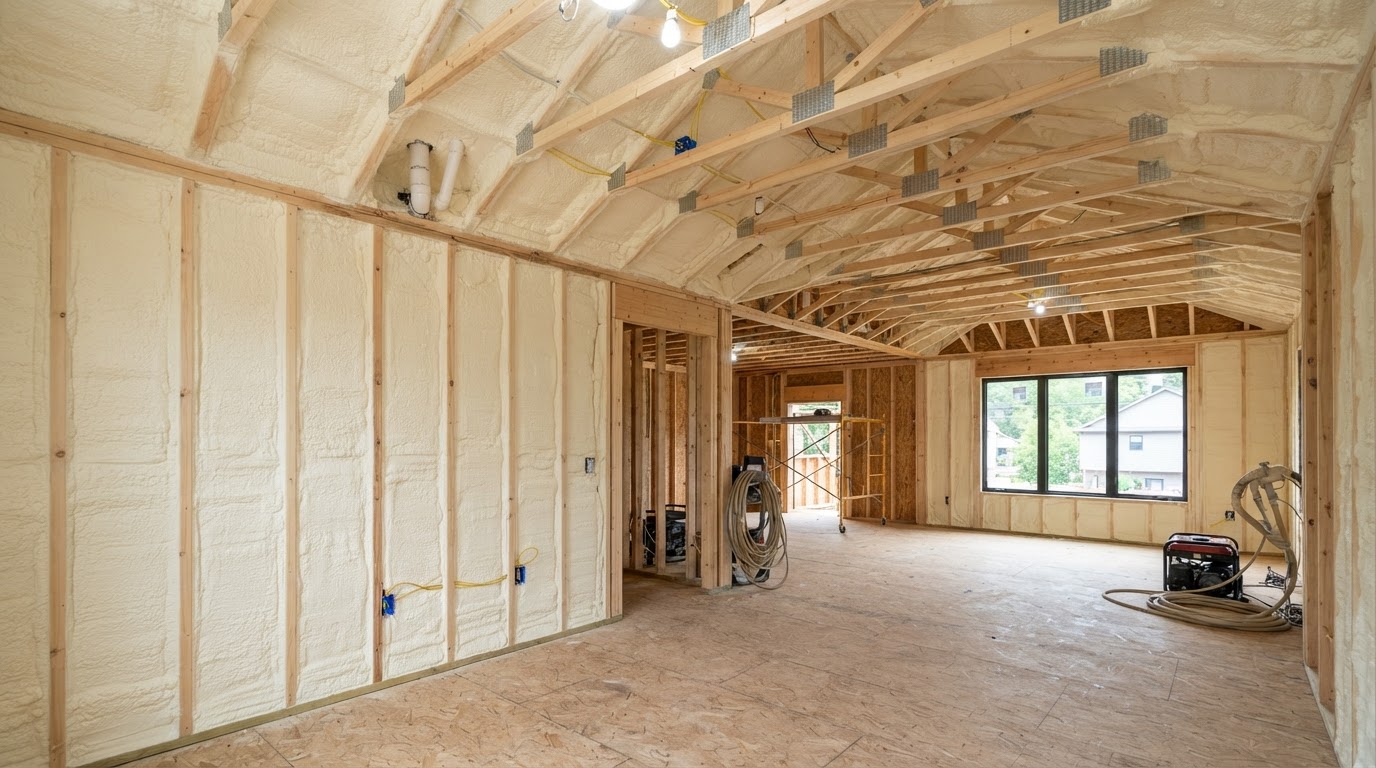
Can You Spray Foam the Underside of a Roof Deck?
Last reviewed: November 5, 2026
Yes — spray foam can be installed against the underside of qualifying roof decks in many residential and commercial assemblies, but the roof condition, substrate, ventilation strategy, foam type, moisture conditions and applicable project requirements must be evaluated first. It should not be used to hide active roof leaks, wet sheathing or deteriorated decking.
What Does "Underside of the Roof Deck" Mean?
The roof deck is the structural surface beneath the exterior roofing system. Residential examples include plywood, oriented strand board (OSB) and plank decking. Commercial examples may include metal deck, wood deck or other qualifying assemblies. Spraying the underside is different from exterior spray polyurethane foam (SPF) roofing — this guide addresses interior insulation beneath or within the roof assembly, not exterior roof coatings or membranes.
When Is Roof Deck Spray Foam Commonly Considered?
Roof-deck spray foam is commonly considered for unvented attic strategies, vaulted ceilings, conditioned attic approaches, metal buildings, commercial roofline insulation, difficult roof framing, HVAC equipment located in the attic, and retrofit roofline projects. The common thread is moving the thermal and air-control boundary toward the roofline rather than the attic floor.
What Must Be Checked Before Spraying the Roof Deck?
This is one of the most important steps. Before any roofline insulation is applied, the following should be evaluated:
Can Spray Foam Hide Roof Leaks?
Spray foam insulation should not be used as a substitute for repairing an active roof leak. Wet materials should be addressed before insulation is installed. Foam does not prevent all future leaks, and covering a leaking deck can conceal a problem that should be corrected first.
Does Spray Foam Damage Roof Sheathing?
Properly designed and installed spray foam assemblies are widely used at rooflines. Problems can occur when moisture is trapped, roof leaks remain unresolved, substrates are wet, the assembly design is inappropriate or installation quality is poor. The issue is usually unresolved moisture rather than the foam itself — which is why roof condition and the moisture strategy should be evaluated before any roofline insulation is added.
Can Roof Sheathing Still Dry?
Drying potential depends on the foam type, its vapor permeability, the roofing assembly, interior conditions, exterior layers and climate. A low-permeability assembly reduces drying in one direction, so the overall moisture strategy matters. Open-cell foam is generally more vapor permeable than closed cell, but no single material or assembly provides universal drying behavior.
Open Cell vs Closed Cell GuideOpen Cell vs Closed Cell on a Roof Deck
| Factor | Open Cell | Closed Cell |
|---|---|---|
| Density | Lower density, softer cured material | Higher density, more rigid cured material |
| R-Value per Inch | Generally lower per inch | Generally higher per inch |
| Vapor Permeability | Generally more vapor permeable | Generally lower vapor permeability |
| Rigidity | Softer, flexible | Rigid, structural in character |
| Cavity Depth | Often used in deeper framing cavities | Often used where depth is limited |
| Metal Deck Consideration | Can adhere to qualifying metal substrates | Often considered for metal roof decks; depends on substrate and moisture strategy |
| Moisture Strategy | More vapor permeable — drying strategy matters | Lower permeability — vapor strategy must be evaluated per product and assembly |
No single roof-deck product is universally correct — the choice follows the roof assembly, vapor strategy, cavity depth and the specific product's data.
What About Roof Warranties?
Roofing manufacturer warranties and installation requirements vary. Property owners should confirm whether an interior insulation change affects any applicable roofing warranty. It may or may not, depending on the manufacturer and product — do not assume it always voids it or never affects it.
Residential vs Commercial Roof Decks
Residential
- • Plywood or OSB roof decking
- • Attic framing and rafters
- • Vaulted ceilings
- • Vented vs unvented attic decisions
Commercial
- • Metal deck or wood deck assemblies
- • Large roof areas
- • High ceilings
- • Occupied building and access considerations
- • Specifications and fire/thermal requirements
When Roof Deck Spray Foam May Not Be Appropriate Yet
Conditions that should be resolved before roofline insulation proceeds:
- Active roof leaks
- Wet sheathing
- Severe corrosion on metal decks
- Deteriorated roof deck
- Unresolved moisture problems
- Incompatible existing coatings
- Inaccessible assembly
- Unclear ventilation strategy
Frequently Asked Questions
Can spray foam be applied directly to roof sheathing?
Yes, in many qualifying residential and commercial roof-deck assemblies — but the roof condition, substrate, ventilation strategy, foam type, moisture conditions and applicable requirements must be evaluated first.
It should not be used to hide active roof leaks, wet sheathing or deteriorated decking. The sheathing must be dry and in suitable condition.
Can you spray foam OSB roof decking?
OSB and plywood roof decks can receive spray foam in qualifying unvented roofline assemblies, provided the deck is dry, structurally sound and compatible with the product.
Existing coatings, moisture, rot and the ventilation strategy all affect suitability. The product's technical documentation and evaluation report should be reviewed.
Can you spray foam a metal roof from inside?
Spray foam can be applied to the underside of qualifying metal roof decks and panels, often in metal buildings and commercial rooflines.
Rust, corrosion, existing coatings, moisture and substrate temperature should be evaluated first. The condensation strategy and interior exposure requirements also matter.
Does spray foam hide roof leaks?
Spray foam should not be used as a substitute for repairing an active roof leak.
Wet materials should be addressed before insulation is installed. Foam does not prevent all future roof leaks, and covering a leaking deck can conceal a problem that should be corrected.
Does spray foam rot roof decking?
Properly designed and installed spray foam assemblies are widely used at rooflines, but problems can occur when moisture is trapped, roof leaks remain unresolved, substrates are wet, the assembly design is inappropriate or installation quality is poor.
The issue is usually unresolved moisture, not the foam itself. Roof condition and the moisture strategy should be evaluated before any roofline insulation is added.
Can roof sheathing still dry after spray foam?
Drying potential depends on the foam type, its vapor permeability, the roofing assembly, interior conditions, exterior layers and climate.
A low-permeability assembly reduces drying in one direction, so the overall moisture strategy matters. Open-cell foam is generally more vapor permeable than closed cell. Do not assume universal drying behavior.
Does spray foam void a roof warranty?
Roofing manufacturer warranties and installation requirements vary.
Property owners should confirm whether an interior insulation change affects any applicable roofing warranty. It may or may not, depending on the manufacturer and product.
Which foam type is used under roof decking?
Both open-cell and closed-cell foams may be used in qualifying roof-deck assemblies, depending on the roof design, vapor strategy, climate, cavity depth and product data.
There is no universal roof-deck product. The choice follows the specific product's technical documentation, the roof assembly and applicable project requirements.
Technical References
- Building America Solution Center / PNNL — unvented roof assemblies, roofline insulation and attic ventilation guidance.
- International Code Council (publicly accessible provisions) — unvented roof assembly and attic ventilation requirements; confirm current locally adopted provisions.
- Spray foam manufacturer technical data and product evaluation reports — product-specific air, vapor, thickness and substrate requirements for roofline applications.
Reviewed for project-planning accuracy by Madison Spray Foam Installation · Last reviewed: November 5, 2026
Request a Roofline Evaluation
Roof-deck spray foam depends on your roof condition, substrate and ventilation strategy. Share your project details for a meaningful evaluation rather than relying on a generic answer.