
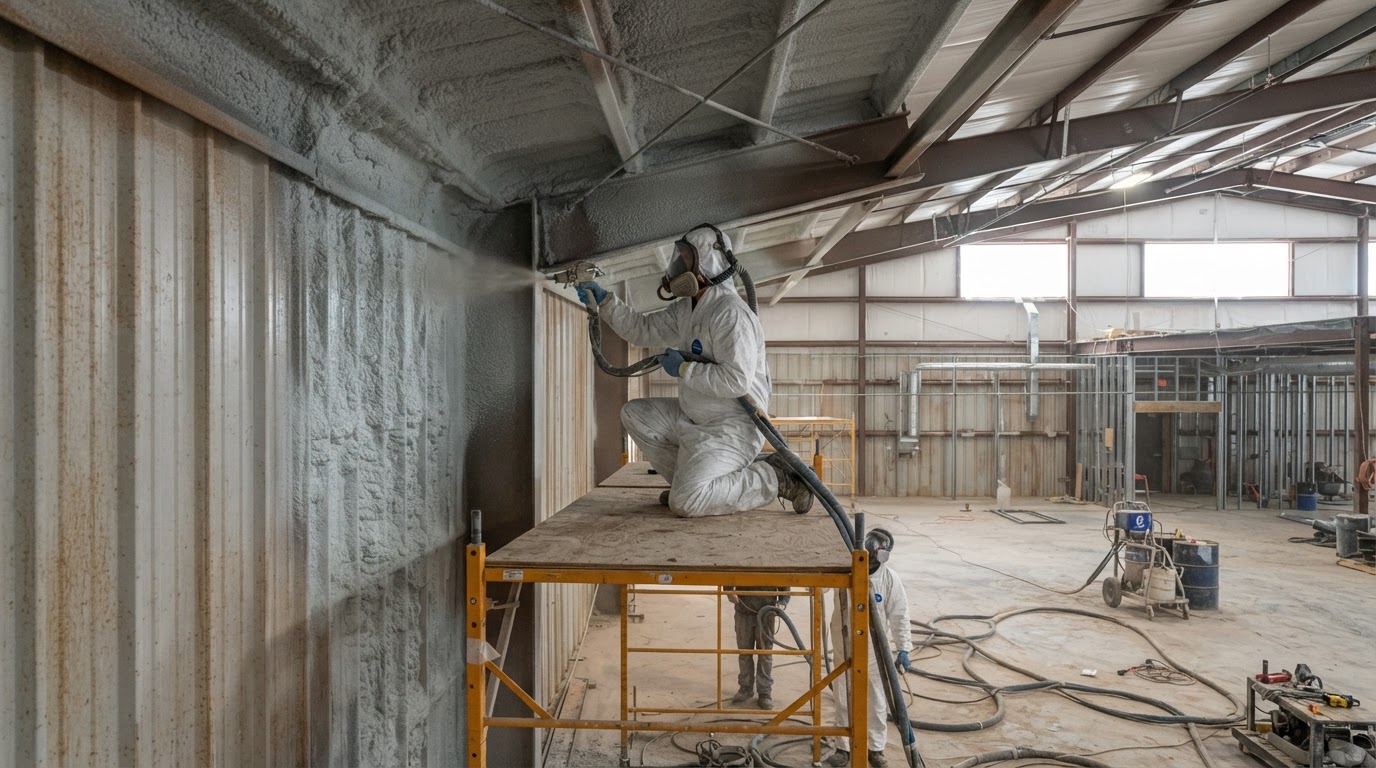
Industrial Spray Foam Insulation in Madison & North Alabama
Industrial spray foam insulation in Madison and North Alabama may be used in qualifying roof, wall, metal-panel and framed building assemblies to provide thermal insulation and reduce uncontrolled air movement. Madison Spray Foam Installation evaluates industrial projects throughout Madison, Huntsville and the surrounding North Alabama region for both new construction and retrofit applications — not every industrial facility is suitable, so each assembly is reviewed before a recommendation is made.
Industrial buildings combine large surface areas, metal construction, tall assemblies and operational constraints that differ from residential work. The foam type, thickness, phasing and access plan depend on the building, its use, and whether the project is part of new construction or an occupied retrofit.
To discuss an industrial project, request an estimate or call (256) 387-9068. We review the building envelope, substrate, access and scheduling before recommending an approach.
Industrial Buildings & Facilities That May Use Spray Foam
Industrial spray foam is evaluated across a range of building types, including manufacturing buildings, warehouses, production facilities, light industrial buildings, fabrication shops, maintenance buildings, equipment buildings, commercial metal buildings, storage facilities and industrial additions. Occupancy, fire-protection requirements, substrate, building height, interior finishes and operational conditions all affect the installation approach.
Because industrial facilities vary widely in construction and use, there is no single foam specification that fits every building. Each assembly is reviewed for substrate condition, framing, moisture exposure, code considerations and the building's operational schedule before a foam type and thickness are recommended.
Where a dedicated page already exists for a related building type — such as our Manufacturing Facility Spray Foam Insulation and Flex Space & Light Industrial Spray Foam Insulation pages — those resources provide more specific planning detail.
Common Reasons Industrial Property Owners Consider Spray Foam
Industrial property owners often consider spray foam for envelope continuity across large surfaces and for air sealing at penetrations and framing transitions. The benefits below describe what is generally achievable when the foam is properly specified and installed; results vary by building and application.
Air Leakage Control
Expanding foam can help reduce uncontrolled air movement through large envelope surfaces, seams and penetrations.
Thermal Continuity
A continuous insulating layer across framing and panels can help limit thermal transfer through the envelope.
Metal Surface Condensation
Direct-to-metal adhesion can help reduce the uncontrolled air contact that contributes to interior condensation on metal assemblies.
Irregular Assembly Coverage
Foam conforms to framing transitions, penetrations and irregular geometry that fibrous insulation leaves open.
Insulation performance, HVAC capacity, ventilation and moisture control are related but separate design considerations. Spray foam does not by itself resolve HVAC sizing problems or guarantee specific energy-cost outcomes. Existing moisture, drainage or operational issues may need to be addressed separately from insulation, and results depend on the assembly, foam selection, installation and operating conditions.
Where Spray Foam May Be Used in Industrial Buildings
The table below summarizes common industrial assemblies, the concerns they raise, the potential role of spray foam, and the factors evaluated before a recommendation is made. Proper application depends on the specific building assembly.
Metal Roof Panels
Concern: large radiant surface. Role: continuous insulation and air sealing on qualifying panels. Factors: panel profile, coating, framing, conditioning plan.
Metal Wall Panels
Concern: conductive heat transfer and condensation. Role: direct-to-panel insulation. Factors: panel condition, existing coatings, interior exposure, fire requirements.
Framed Exterior Walls
Concern: air leakage at cavities and penetrations. Role: cavity insulation and air seal. Factors: framing depth, substrate, finish, code requirements.
Roof Decks
Concern: thermal transfer and air movement at the roof line. Role: underside insulation on qualifying decks. Factors: deck type, access, height, venting.
Industrial Additions
Concern: continuity between new and existing construction. Role: envelope insulation at the addition. Factors: assembly match, sequencing, transitions.
Retrofit Wall / Roof Areas
Concern: existing insulation and occupied operations. Role: retrofit insulation where accessible. Factors: substrate prep, existing materials, scheduling, occupancy.
For roof-specific planning, see our Roof Deck Spray Foam Insulation page. For metal structures generally, see our Metal Building Spray Foam Insulation page.
Industrial Spray Foam for Madison, Huntsville & North Alabama
Madison Spray Foam Installation evaluates industrial spray foam projects for properties in Madison, AL 35758 and surrounding North Alabama communities, with Madison and Huntsville as core commercial markets. Industrial work brings planning considerations that residential projects do not — larger surface areas, access at height, occupied operations and coordination with facility schedules.
We evaluate each industrial building before recommending a specification rather than applying a single approach. That includes reviewing the substrate, the foam type and thickness appropriate for each assembly, and the preparation and access required before any material is sprayed.
The related service pages below offer more detail on the building types and assemblies involved in industrial spray foam work.
Industrial Spray Foam Insulation FAQs
Can spray foam be used in industrial metal buildings?
Yes, spray foam is commonly evaluated for industrial metal buildings because it adheres directly to steel panels and framing and can help reduce uncontrolled air leakage.
Direct-to-metal application can help manage interior surface conditions on metal assemblies. The appropriate foam type and thickness depend on the panel profile, framing, building use and applicable requirements.
Is spray foam suitable for existing industrial facilities?
Yes, qualifying existing industrial facilities may be retrofitted with spray foam where the substrate is accessible, clean and suitable for adhesion.
Retrofit planning includes existing insulation, substrate condition, occupied operations, access and scheduling around facility use. We evaluate the building before recommending a retrofit approach.
Which foam type is commonly used in industrial buildings?
Industrial projects are often associated with closed-cell foam, but product selection is not determined solely by building type — the assembly, substrate, framing depth, vapor considerations and fire requirements all factor in.
Open-cell foam may be appropriate for some framed or interior industrial assemblies. We recommend a foam type per assembly rather than one product for an entire facility.
Can spray foam help with condensation on metal panels?
Spray foam may help reduce the uncontrolled air contact that contributes to condensation on interior metal surfaces, but it does not eliminate all condensation.
Condensation also depends on ventilation, HVAC operation, indoor humidity and drainage. Insulation and air control are one part of an overall moisture strategy.
Can industrial spray foam be installed while a building is occupied?
Spray foam may be installed in occupied industrial facilities, but the work requires planning around operations, equipment protection, ventilation and re-entry timing.
Scheduling and work-zone requirements depend on the facility and the product used. We review the building and operational schedule before proposing an approach.
What affects industrial spray foam cost?
Cost depends on surface area, foam type, thickness, access and staging, building height, substrate preparation, existing insulation and whether the project is new construction or a retrofit.
Large industrial envelopes involve different logistics than smaller projects. Request an estimate to review the variables that apply to your building.
Can spray foam be installed on roof-deck assemblies?
Spray foam can be applied to the underside of qualifying roof-deck assemblies as insulation within the building envelope.
This is distinct from exterior spray polyurethane foam roofing, which is a separate service not advertised here. Suitability depends on the roof assembly, access and conditioning plan.
What information should I send for an industrial estimate?
Useful details include project location, building use, overall dimensions, the target insulation area, wall and roof heights, substrate, photos, plans when available, existing insulation, access constraints, occupied status, construction schedule and any known fire or thermal barrier requirements.
Sharing these details helps us evaluate the assembly and provide a meaningful response.
Related Spray Foam Services
Request an Industrial Spray Foam Project Evaluation
Tell us about your industrial building, the assemblies involved and your operational schedule. We will review the envelope, evaluate the substrate and access, and recommend a spray foam approach for your Madison or North Alabama property.