
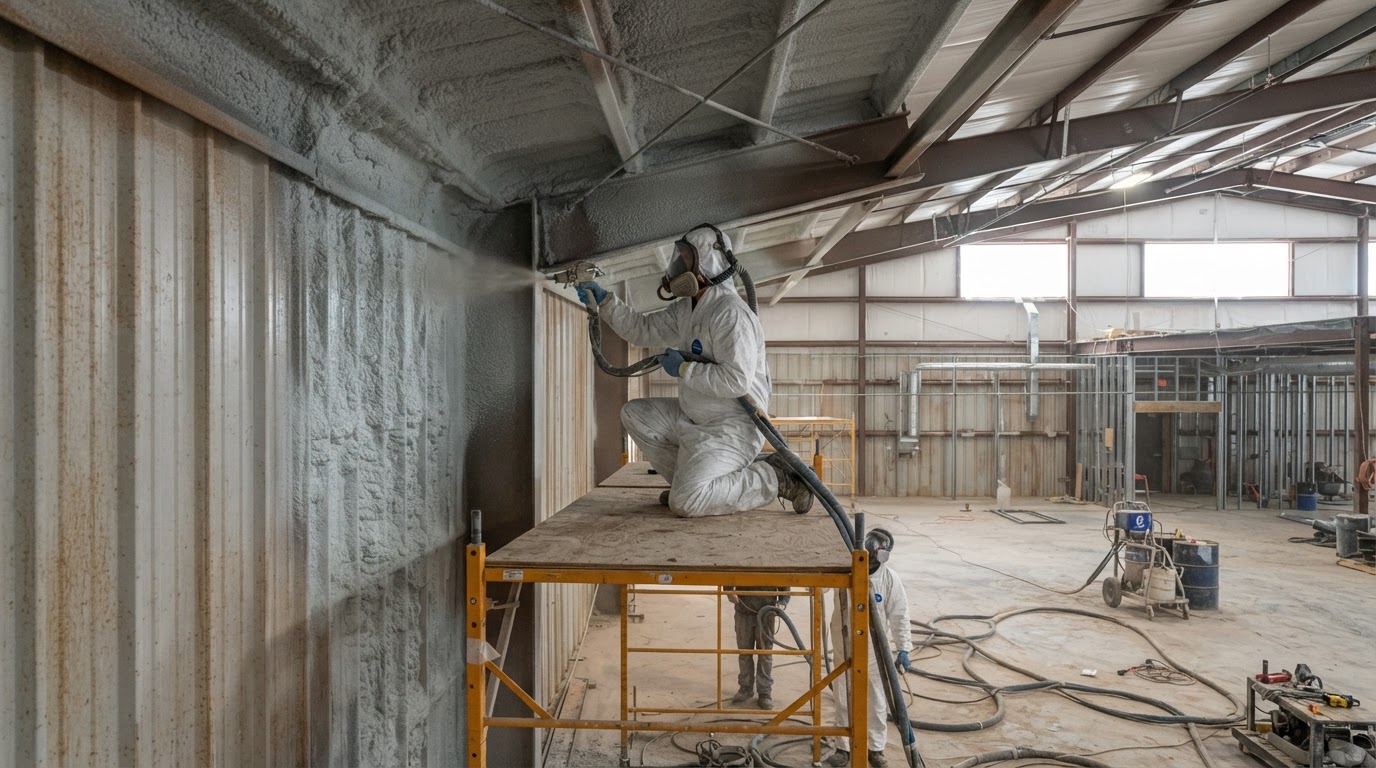
CMU & Masonry Wall Spray Foam Insulation in North Alabama
Concrete masonry unit (CMU) and masonry buildings in Madison, Huntsville and North Alabama often require insulation as part of a larger wall assembly. Spray foam may be installed on qualifying interior surfaces or adjacent framed assemblies depending on wall design, moisture exposure, finishes and project requirements.
Spray foam should not be used to conceal an unresolved bulk-water problem. Exterior drainage, flashing and water-management defects should be addressed separately before insulation is considered. Spray foam does not waterproof masonry — it is a thermal insulation and air-sealing component within the wall assembly.
To discuss a CMU or masonry wall project, request an evaluation or call (256) 387-9068. We review the wall type, interior framing, moisture history and substrate before recommending an approach.
What Is a CMU Wall?
CMU stands for concrete masonry unit, commonly called concrete block. Commercial buildings may use single-wythe CMU, multi-layer masonry assemblies, brick veneer with a backup wall, CMU with interior framing, CMU with furring, or mixed masonry and framed construction. Each assembly has different insulation and air-sealing requirements.
Spray polyurethane foam may fit in a masonry wall assembly in several ways: on the interior side of a qualifying masonry wall, within a framed wall built inside the CMU, in a furred wall assembly, or at transitions between masonry and framed construction. This page addresses spray-applied polyurethane foam, not injection foam. We do not recommend filling CMU cores unless that specific service and product is independently verified and appropriate for the assembly.
Because masonry assemblies vary widely in construction and exposure, there is no single foam specification that fits every wall. Each assembly is reviewed for substrate condition, moisture history, framing, interior finish and code considerations before a foam type and thickness are recommended.
Masonry Moisture Must Be Evaluated First
Moisture is the most important evaluation factor for masonry walls. The benefits below describe what is generally achievable when the foam is properly specified and installed; results vary by wall and assembly.
Bulk Water Check
Cracks, rising damp, leaks and exterior drainage defects must be identified before insulation is considered.
Air-Leakage Paths
Unsealed masonry joints and transitions can allow uncontrolled air movement through the wall.
Thermal Continuity
Foam can add a continuous insulation layer at the interior or within a framed cavity.
Substrate Suitability
Dust, loose coatings, efflorescence and deteriorated masonry must be evaluated before application.
Spray foam should not be used to conceal an unresolved bulk-water problem. Exterior drainage, flashing and water-management defects should be addressed separately. Spray foam does not waterproof masonry. Surface preparation — including dust removal, evaluation of existing coatings, efflorescence, moisture, paint, sealers, contamination and surface temperature — must be completed before application. We do not promise adhesion to every painted or sealed wall.
Framed Wall vs Direct Application
The table below compares common masonry wall insulation approaches. potential advantages and important considerations. Proper application depends on the specific wall assembly and project requirements.
Interior Framed Wall Against CMU
Advantages: deep cavity for R-value, services run in the cavity, finish is standard drywall. Considerations: floor area lost to the framed wall, thermal bridging at framing.
Furred Wall Assembly
Advantages: thinner profile, foam directly against masonry. Considerations: limited cavity depth, furring attachment must be suitable, vapor characteristics must match.
Direct Application to Qualifying Masonry
Advantages: no cavity needed, foam adheres to clean masonry. Considerations: substrate must be clean and suitable, interior exposure must be acceptable, fire-protection requirements may apply.
Mixed Masonry / Framed Transition
Advantages: continuity at the transition. Considerations: air sealing at the interface, differential movement, moisture strategy must be assembly-specific.
We do not prescribe one approach as universally best. The appropriate approach depends on the wall type, moisture history, interior finish, fire-protection requirements and project objectives.
CMU & Masonry Wall Spray Foam Near Madison & North Alabama
Madison Spray Foam Installation evaluates CMU and masonry wall spray foam projects for properties in Madison, AL 35758 and surrounding North Alabama communities, with Madison and Huntsville as core commercial markets. Masonry work brings planning considerations that differ from framed construction — substrate condition, moisture history and existing finishes all affect what is possible.
We evaluate each masonry wall before recommending a specification rather than applying a single approach. That includes reviewing the wall type, interior framing or furring, moisture history, substrate condition, and the foam type and thickness appropriate for the assembly.
The related service pages below offer more detail on the assemblies involved in CMU and masonry wall projects.
CMU & Masonry Wall Spray Foam FAQs
Can spray foam be applied to concrete block walls?
Spray polyurethane foam may be applied to the interior surface of qualifying concrete block walls where the substrate is clean, dry and suitable for adhesion.
Direct application depends on substrate condition, moisture history, interior exposure and fire-protection requirements. Not every block wall is a candidate for direct application.
What does CMU mean?
CMU stands for concrete masonry unit, commonly called concrete block. Commercial buildings may use single-wythe CMU, multi-layer masonry, brick veneer with backup, or CMU with interior framing.
Each assembly has different insulation and air-sealing requirements. The wall type must be identified before a foam approach is recommended.
Does spray foam waterproof a block wall?
No. Spray foam is a thermal insulation and air-sealing component within the wall assembly. It does not replace exterior waterproofing, flashing or drainage.
Spray foam should not be used to conceal an unresolved bulk-water problem. Exterior drainage and water-management defects should be addressed separately.
Can wet masonry be spray foamed?
Wet masonry should not be insulated until the moisture source is identified and addressed. Spray foam should not be applied over wet or contaminated surfaces.
Moisture history — including bulk water, rising damp, condensation and efflorescence — must be evaluated before any insulation is installed.
Can spray foam be used behind an interior framed wall?
Yes. A framed wall built inside the CMU creates a cavity where spray foam can be applied to the framing and the masonry face.
This is a common approach when a deeper cavity is needed for R-value, when services run in the wall, or when the interior finish is standard drywall.
Which foam type is used near masonry?
Either open-cell or closed-cell foam may be appropriate depending on the cavity depth, moisture exposure, vapor characteristics, substrate and fire-protection requirements.
We do not state that closed-cell must always be used against masonry. Moisture strategy is assembly-specific and depends on the wall type, climate and interior conditions.
Can existing commercial block buildings be retrofitted?
Qualifying existing commercial block buildings can be retrofitted where the substrate is accessible, clean and suitable for adhesion or where a framed cavity can be built.
Retrofit planning includes existing finishes, coatings, moisture history, occupancy and access. Finished walls may require selective demolition or access openings.
What affects masonry-wall spray foam pricing?
Factors include wall area, foam type, thickness, substrate preparation, moisture remediation, access, interior finish requirements and protective barriers where applicable.
Existing coatings, efflorescence and deteriorated masonry can add preparation steps that affect the project scope.
Related Spray Foam Services
Request a Masonry Wall Evaluation
Tell us about your commercial masonry building — the wall type, interior framing, moisture history and substrate condition. We will review the assembly, evaluate the substrate and access, and recommend a spray foam approach for your Madison or North Alabama property.