
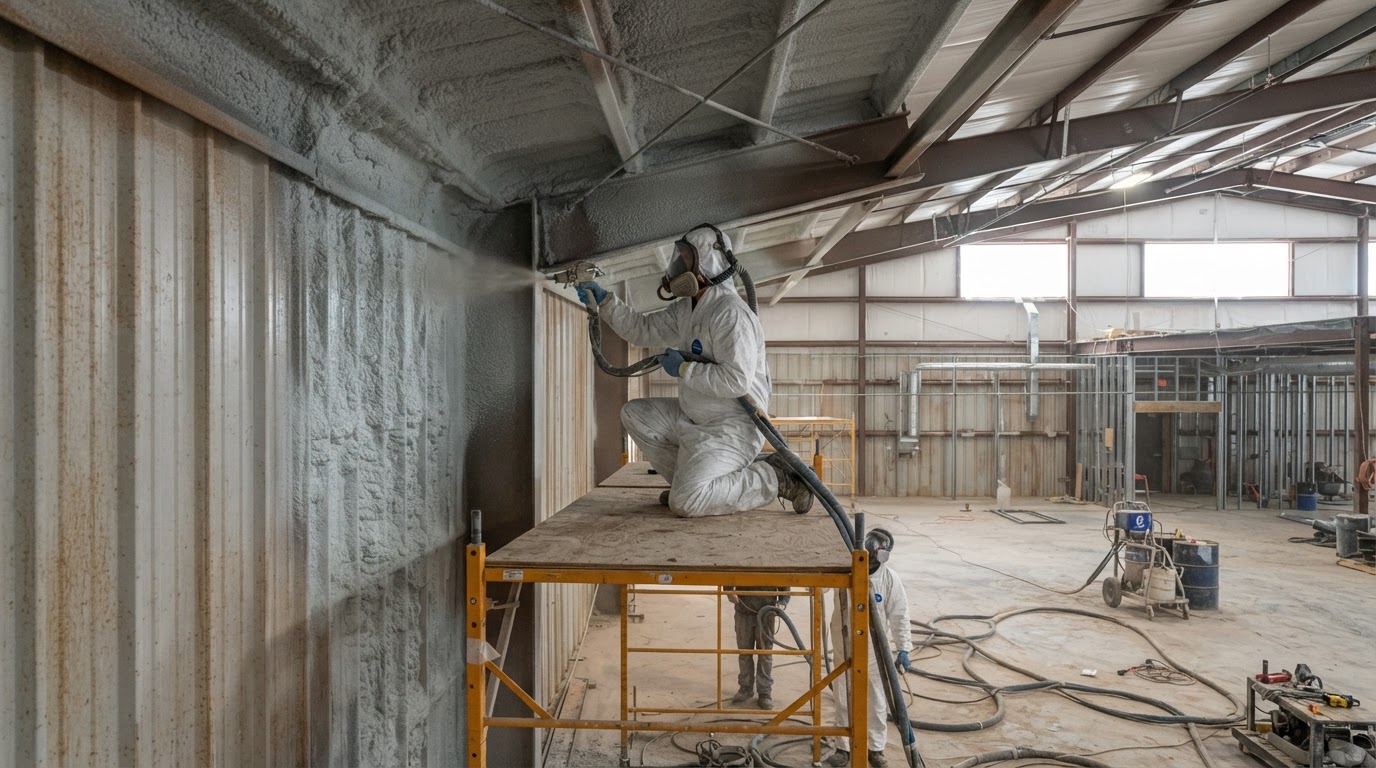
Flex Space & Light Industrial Spray Foam Insulation in North Alabama
Flex and light-industrial buildings often combine warehouse, service, production and office areas in one structure. Because different portions of the same building may have different conditioning requirements, the insulation strategy should follow the actual use and envelope of each area. Madison Spray Foam Installation evaluates flex-space and light-industrial projects throughout Madison, Huntsville and the surrounding North Alabama region for new construction and retrofit work.
What makes a flex building different from a single-use warehouse is that one structure can hold fully conditioned offices, semi-conditioned warehouse space, service bays with large doors and storage with its own temperature requirements. A single foam depth or product is rarely the right answer for the whole building.
To discuss a flex-space project, request an estimate or call (256) 387-9068. We review the building, the areas being conditioned and the assemblies involved before recommending an approach.
What Is a Flex or Light Industrial Building?
A flex or light-industrial building is a structure that combines several uses under one roof. It may include warehouse and storage, office space, a showroom, light assembly, a repair or service area, small production and a loading or receiving area. The mix is what makes the category distinct: a single building can contain spaces with very different thermal loads.
Because the uses vary, the thermal boundary varies too. Offices may be fully conditioned for staff comfort, while warehouse areas may be semi-conditioned and service bays may experience large air exchange when overhead doors open. Storage may have its own temperature or moisture requirements depending on what is kept there.
That is why a flex-space insulation plan is built area by area. We do not recommend a single uniform foam depth without evaluating how each portion of the building is used and constructed.
Different Areas of a Flex Building May Need Different Insulation Strategies
The central planning question in a flex-space project is how to separate and insulate the thermal zones within one building. The areas below show how conditioning requirements can differ, and the table summarizes what we evaluate for each.
Office Areas
May be fully conditioned; wall and ceiling boundaries and the interface to the adjacent warehouse are evaluated.
Warehouse Areas
May be semi-conditioned; door frequency, roof type and the metal envelope shape the approach.
Service Bays
Large overhead doors drive air exchange; exterior wall construction and door use are evaluated.
Storage & Mezzanines
Vary by inventory; temperature, moisture and mezzanine boundaries are reviewed per use.
We do not promise soundproofing between spaces. Some foam assemblies may provide acoustic benefits, but sound performance depends on the full wall and ceiling assembly, not the foam alone. Existing moisture, drainage or HVAC conditions may need separate attention from insulation.
Common Flex & Light Industrial Spray Foam Applications
The table below summarizes common flex-space areas, their typical conditions and the primary evaluation questions for each. It is a planning aid, not a substitute for project-specific evaluation.
Warehouse
Large open volume. Evaluated for: conditioned or unconditioned? Door frequency? Roof type?
Office
Fully conditioned. Evaluated for: wall and ceiling boundary? Adjacent warehouse temperature?
Service Bay
Large overhead doors. Evaluated for: how often open? Exterior wall construction?
Storage
Varies by inventory. Evaluated for: temperature and moisture requirements?
Mezzanine
Intermediate level. Evaluated for: floor and ceiling boundary? Adjacent zone temperature?
Loading / Receiving
Door exposure. Evaluated for: door use? Demising wall and roof assembly?
For warehouse-focused planning, see our Warehouse Spray Foam Insulation page. For new construction, see our New Construction Spray Foam Insulation page.
Flex-Space Spray Foam for Madison, Huntsville & North Alabama
New flex-space construction benefits from early insulation planning: separating thermal zones, defining the roof and wall assembly, planning the office-to-warehouse interface, sequencing with other trades, and addressing fire and finish requirements, loading-door areas and future tenant flexibility. For new builds, see our New Construction Spray Foam Insulation page for construction-stage context.
Existing flex and light-industrial buildings are often retrofitted through tenant improvements: converting warehouse space to conditioned workspace, adding offices, improving the existing metal-building envelope, addressing old insulation and evaluating existing coatings or panels. We do not imply that foam can be sprayed blindly over existing insulation — substrates and existing materials are evaluated first.
Service buildings and contractor flex spaces — such as HVAC, electrical or plumbing contractors, small fabrication, equipment service, trades, distribution and local service businesses — have common project needs we plan around. We do not imply that any of these businesses are existing customers. Madison Spray Foam Installation evaluates flex-space projects throughout Madison, AL 35758 and the surrounding North Alabama region, with Madison and Huntsville as core commercial markets.
Flex Space & Light Industrial Spray Foam FAQs
What is a flex-space building?
A flex-space building combines several uses under one roof — commonly warehouse, office, showroom, service bay, light production and loading or receiving areas.
Because the uses differ, the thermal boundary and conditioning plan differ by area rather than applying uniformly to the whole building.
Can spray foam be used in warehouse-office buildings?
Yes, spray foam may be evaluated for warehouse-office buildings, with the office and warehouse portions planned to their respective conditioning standards.
The demising wall, ceiling boundaries and the interface between conditioned office and warehouse are reviewed along with the metal envelope.
Can different parts of one building use different foam types?
Yes. Framed office walls may suit one product while metal warehouse roof or wall panels may suit another.
We recommend a foam type per assembly rather than a single hybrid system without evaluation. The building's use and envelope drive the selection.
Can existing flex buildings be upgraded with spray foam?
Yes, qualifying existing flex buildings may be retrofitted, including tenant improvements that convert warehouse space to conditioned workspace or add offices.
Existing insulation, coatings, panel condition and substrate suitability are evaluated first. Foam should not be sprayed blindly over existing materials without review.
How does insulation change when large overhead doors are used frequently?
Frequent door operation increases air exchange, so the plan accounts for the exterior wall construction, door use and the conditioning standard for the bay.
Insulation and air sealing can help between door cycles, but no insulation prevents all air exchange while doors are open. The plan follows how the bay is actually used.
Can spray foam be installed above office areas inside a warehouse?
Yes, the ceiling and demising boundaries above office areas within a warehouse can be evaluated for insulation and air sealing.
The adjacent warehouse temperature, the ceiling or roof assembly and the wall boundary are reviewed together so the office is planned as part of the larger envelope.
What affects flex-space insulation cost?
Cost depends on the areas insulated, foam type and thickness, metal versus framed surfaces, ceiling height, overhead doors, existing insulation, access and whether the project is new construction or a retrofit.
Mixed-use buildings are quoted area by area. Request an estimate to review the variables that apply to your property.
Do you work on small commercial buildings as well as large industrial facilities?
Yes, we evaluate small commercial and light-industrial buildings as well as larger facilities across Madison, Huntsville and North Alabama.
Flex and light-industrial projects are planned to the building's actual size and use. See our Commercial & Industrial hub for the broader commercial offering.
Related Spray Foam Services
Request a Flex-Space Project Evaluation
Tell us about your flex or light-industrial building, the areas being conditioned and the office-to-warehouse layout. We will review the assemblies, evaluate the substrate and access, and recommend a spray foam approach for your Madison or North Alabama property.