
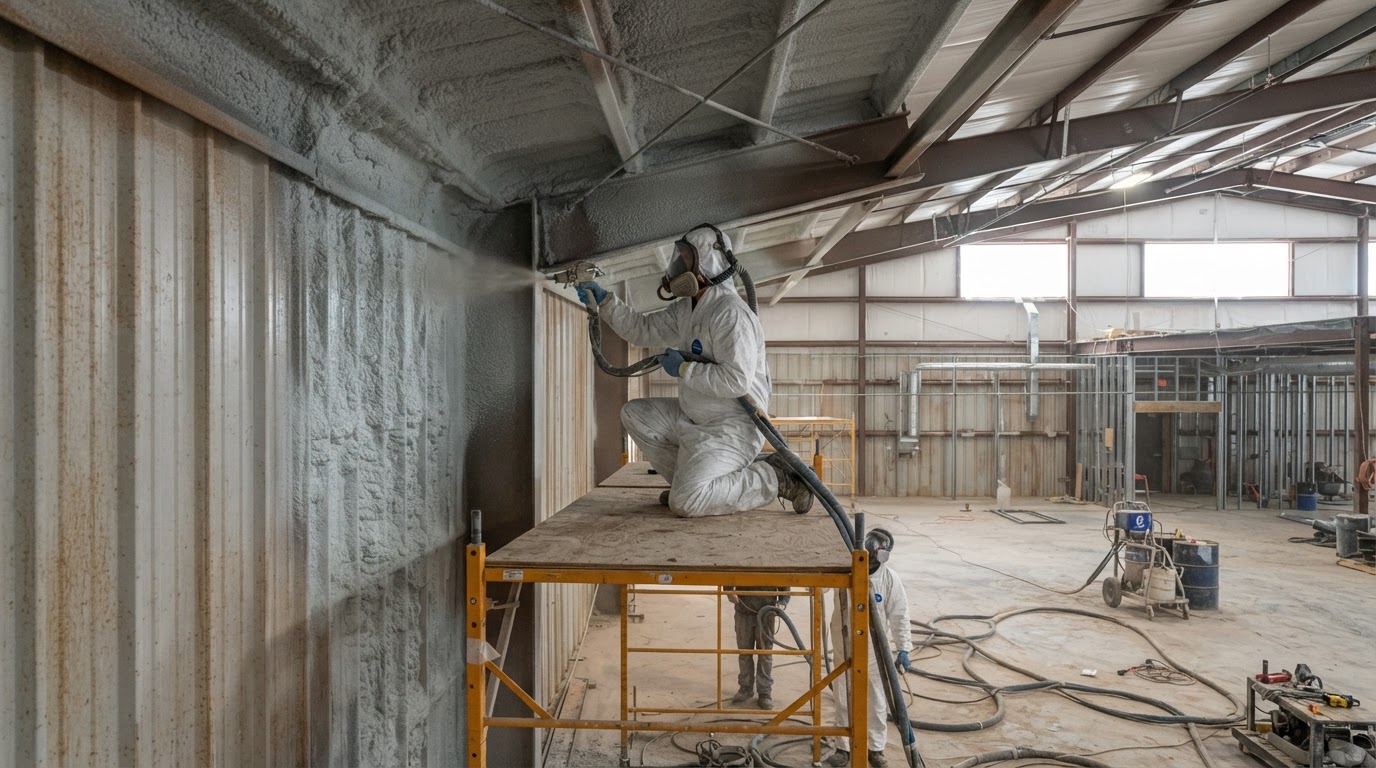
Aircraft Hangar Spray Foam Insulation in Huntsville & North Alabama
Aircraft hangars commonly combine large metal roof and wall areas, tall interiors and wide door openings. Spray foam may be used on qualifying envelope assemblies to provide continuous insulation and reduce uncontrolled air movement when compatible with the building design and operational requirements. Madison Spray Foam Installation evaluates hangar projects throughout Huntsville, Madison and the surrounding North Alabama region.
Hangar insulation is distinct from other commercial work because of the clear-span volume, the door openings, and the equipment and aircraft that must be protected during application. The foam type, thickness, access plan and scheduling follow the building, its use and the operational calendar.
To discuss a hangar project, request an estimate or call (256) 387-9068. We review the metal assemblies, panel condition, access and schedule before recommending an approach.
Insulation Challenges in Aircraft Hangars
Hangars present conditions few other buildings do. Large clear-span spaces and tall rooflines mean a single envelope decision affects a very large volume. Metal wall and roof panels conduct heat and, in North Alabama's humid climate, can experience condensation when warm moisture-bearing air reaches a surface below its dew point.
Large hangar doors drive much of the envelope behavior. When doors open for aircraft movement, air exchange is significant, and no insulation can prevent all temperature loss during that exchange. The insulation plan has to account for how often the doors operate, the attached offices and maintenance areas, and the storage rooms that share the building.
Radiant heat gain through the large roof area, high interior volume and air leakage at unsealed metal joints all shape the evaluation. We review the panel condition, existing coatings, oils or contaminants, rust, moisture and substrate temperature before recommending where and how to apply foam.
Common Reasons Hangar Owners Consider Spray Foam
Hangar owners often consider spray foam for envelope continuity across large metal surfaces and for air sealing at panel laps and framing transitions. The benefits below describe what is generally achievable when the foam is properly specified and installed; results vary by building and application, and spray foam does not prevent all temperature loss when large doors are opened.
Large Metal Surface Coverage
A continuous insulating layer across large roof and wall panels can help limit thermal transfer through the envelope.
Air Leakage Control
Expanding foam can help reduce uncontrolled air movement at panel laps, fastener rows and framing transitions.
Surface Condensation
Direct-to-metal adhesion can help reduce the air contact that contributes to condensation on interior metal surfaces.
Mixed-Use Planning
Hangar floor, office and storage areas can be planned to different conditioning standards where appropriate.
Condensation control may also involve ventilation, HVAC operation, indoor humidity, drainage and other building conditions; insulation and air control are only one part of the strategy. We do not claim that spray foam prevents all temperature loss when hangar doors are opened, and existing moisture or coating conditions may need to be addressed separately.
Evaluating a Hangar for Spray Foam Insulation
Hangar projects demand planning before spraying, especially for tall structures and occupied facilities. The steps below reflect how we evaluate and plan an aircraft hangar spray foam project in the Huntsville and Madison area.
Review Hangar & Operations
We discuss the hangar type, door use, aircraft and equipment occupancy and operational schedule.
Assess Panels & Access
We evaluate metal roof and wall assemblies, panel condition, existing coatings, access at height and any existing insulation.
Plan Foam & Protection
We recommend foam type and thickness and outline equipment protection, masking and re-entry planning.
Prepare the Hangar
Aircraft, tools and equipment are removed from active spray zones or covered, and substrates are verified suitable for adhesion.
Controlled Application
Foam is applied in controlled work zones with access planned for the roof and wall heights involved.
Completion Review
We verify coverage and depth and review finishing, re-entry and sequencing with the owner or facility team.
For general metal-building and condensation guidance, see our Metal Building Spray Foam Insulation page. For roof-specific planning, see our Roof Deck Spray Foam Insulation page.
Aircraft Hangar Spray Foam Near Huntsville, Alabama
Huntsville and the surrounding North Alabama region contain aviation and aerospace facilities in general terms, and Madison Spray Foam Installation evaluates hangar spray foam projects throughout Huntsville, Madison and the surrounding area. We do not claim relationships with specific airports, military installations, defense contractors or aerospace companies, and this page does not imply any such vendor or customer relationship.
Access and project planning for large, tall hangars involves roof and wall height, lifts or scaffolding and access systems, door clearances, floor space, obstruction planning, sequencing and facility operation schedules. We do not claim ownership of specific lift equipment; access requirements are evaluated per project.
During installation, spray application requires controlled work zones. Aircraft may need to be removed from active spray zones where required, and equipment, floors, doors, windows, fixtures and mechanical and electrical systems are masked and protected. Overspray is controlled and access is restricted during application and cure or re-entry periods as applicable. Re-entry timing depends on the product, ventilation and manufacturer requirements — we do not quote fixed re-entry times.
Aircraft Hangar Spray Foam Insulation FAQs
Can spray foam be applied directly to metal aircraft hangars?
Yes, spray polyurethane foam adheres directly to qualifying metal wall and roof panels, which can help reduce air leakage and manage interior surface conditions.
Panel condition, existing coatings, oils or contaminants, rust, moisture and substrate temperature are evaluated first. Foam should not be installed over active corrosion or wet surfaces without proper evaluation and preparation.
Which spray foam is used in aircraft hangars?
Closed-cell foam is often considered for metal hangar assemblies because of its density, rigidity and vapor characteristics, but it is not prescribed for every hangar.
Framed office areas, interior partitions and some assemblies may suit open-cell foam. We recommend a foam type per assembly rather than one product for the entire building.
Can spray foam help reduce metal-roof condensation?
Spray foam may help limit direct interior-air contact with qualifying metal surfaces and add insulation, which can reduce the conditions that lead to condensation.
Condensation control may also involve ventilation, HVAC operation, indoor humidity and drainage. Insulation and air control are one part of an overall moisture strategy.
Does aircraft need to be removed during spray foam installation?
Aircraft may need to be removed from active spray zones where required, and equipment, tools and mechanical systems are protected or masked.
Spray application requires controlled work zones, and access is restricted during application and cure or re-entry periods as applicable. The plan depends on the facility and the areas being insulated.
Can an existing hangar be retrofitted?
Yes, qualifying existing hangars may be retrofitted with spray foam where assemblies are accessible and the substrate is suitable for adhesion.
Retrofit planning includes existing insulation, panel and coating condition, access at height, occupancy and scheduling around facility use.
How is overspray controlled in a hangar?
Overspray is controlled through defined work zones, masking of adjacent surfaces and equipment, and restricted access during application and cure.
Re-entry timing depends on the specific product, ventilation and manufacturer requirements rather than a single fixed period.
What affects hangar spray foam cost?
Cost depends on surface area, foam type, thickness, building height, access and staging, panel preparation, existing insulation and whether the project is new construction or a retrofit.
Large clear-span hangars involve different logistics than smaller projects. Request an estimate to review the variables that apply to your building.
Do you serve hangars outside Huntsville?
We evaluate qualifying hangar projects throughout Huntsville, Madison and the surrounding North Alabama region.
Larger projects may be considered outside the typical residential service radius based on project scope and scheduling. See our Service Areas hub for the current published areas.
Related Spray Foam Services
Request a Hangar Spray Foam Project Evaluation
Tell us about your hangar, the metal assemblies involved and your operational schedule. We will review the panels and access, evaluate the substrate, and recommend a spray foam approach for your Huntsville or North Alabama facility.